
Why Understanding Myopia Matters More Than Ever
What causes myopia is a question more parents and adults are asking as rates of short-sightedness continue to climb worldwide. The answer isn’t simple—it’s a combination of factors:
- Genetics: Having one or both parents with myopia significantly increases your risk
- Environmental factors: Prolonged close-up work (reading, screens) and limited outdoor time
- Visual stress: Extended periods focusing on near objects, especially digital devices
- Health conditions: Diabetes and other medical issues can trigger or worsen myopia
- Lifestyle: Urban living, higher education levels, and reduced sunlight exposure
Myopia, or short-sightedness, affects nearly 30% of Australians—and that number has almost doubled since the 1970s. In some parts of Asia, up to 90% of school-aged children are now myopic. This isn’t just about needing glasses to see the whiteboard clearly. When myopia progresses unchecked, the eye elongates and stretches the retina, increasing the risk of serious conditions like retinal detachment, glaucoma, and macular degeneration later in life.
The good news? We now understand what causes myopia well enough to actively manage its progression, especially in children. Modern myopia management strategies—including specialty contact lenses like Ortho-K and MiSight, lifestyle modifications, and regular monitoring—can significantly slow eye elongation and reduce long-term risks.
I’m Bernie Eastwood, and I’ve spent over 20 years helping families understand what causes myopia and how to protect their children’s vision for the long term. At The Focal Point Optometrist, we’ve seen how early intervention and personalised myopia management can make a real difference in preventing the progression of short-sightedness and the complications it can bring.
Let’s break down exactly what’s happening in myopic eyes, why it’s becoming so common, and what you can actually do about it.
Understanding Myopia: More Than Just Blurry Distance Vision
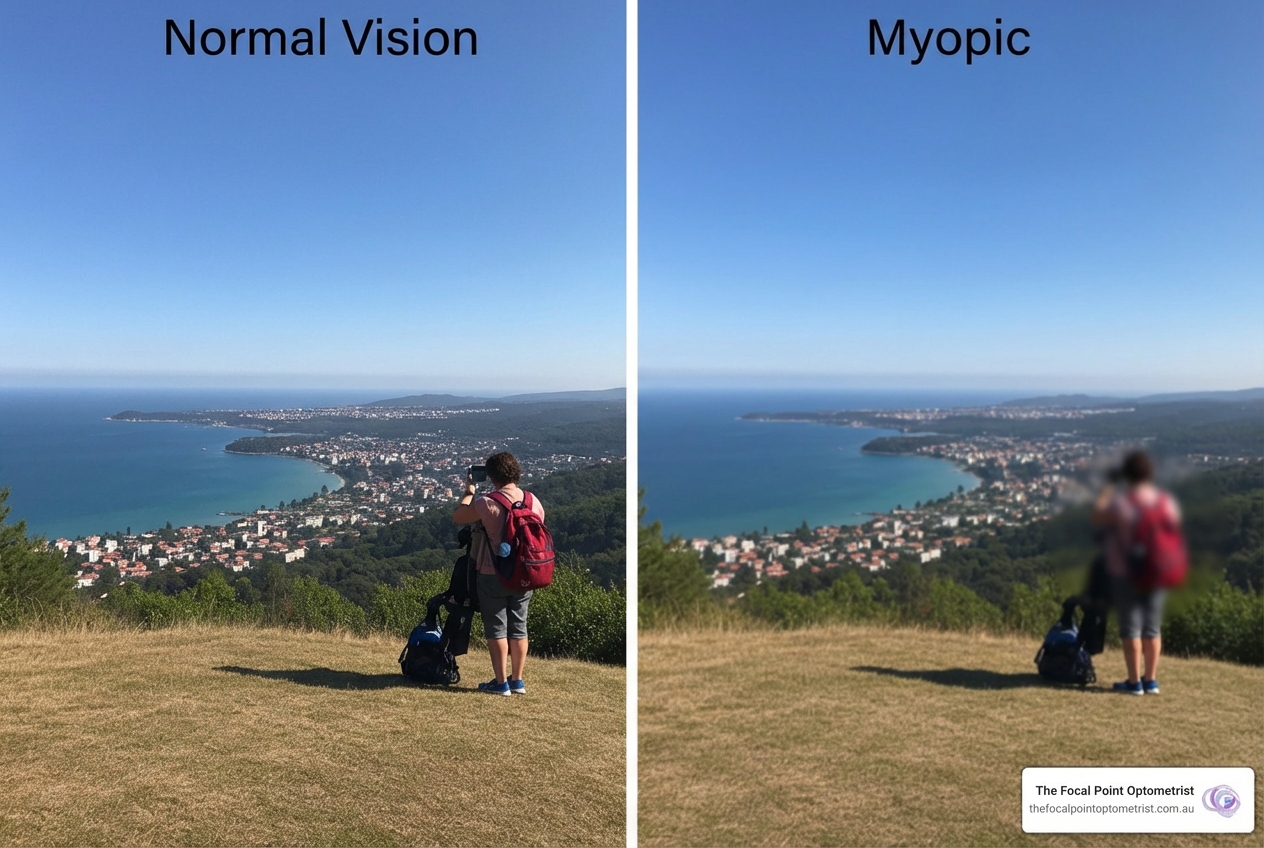
Myopia, commonly known as short-sightedness or nearsightedness, is a prevalent vision condition where distant objects appear blurry, while close-up objects remain clear. The American Optometric Association estimates that myopia impacts nearly 30% of Americans, making it one of the most common vision problems. The National Eye Institute reports that the number of Americans with myopia has nearly doubled since 1971, a trend also observed in Australia and other parts of the world. In East and Southeast Asia, a staggering 80-90% of children with 12 years of schooling have myopia. This global rise highlights the urgency of understanding this condition.
So, how does myopia affect vision? In a healthy eye, light rays entering the eye are precisely focused by the cornea and the lens onto the retina at the back of the eye. The retina then converts these light rays into signals that are sent to the brain, forming a clear image. With myopia, however, this process is disrupted. The eye’s shape causes light rays to focus in front of the retina instead of directly on it. This misdirected focus is what makes distant objects appear blurry.
There are two primary reasons why this happens:
- Axial Elongation: The most common cause of myopia is when the eyeball grows too long from front to back. Imagine your eye as a camera; if the film (retina) is too far back, the image will be out of focus. This elongation stretches the delicate tissues of the retina and choroid, which can lead to significant long-term complications.
- Cornea Curvature: Sometimes, the cornea (the clear front surface of the eye) is too steeply curved. A steeper curve means it bends light more aggressively, causing the focal point to fall short of the retina.
While most cases of myopia are mild and easily managed with corrective spectacles or contact lenses, high myopia, defined as -6.00 diopters or more, presents a higher risk of serious eye conditions. Understanding these fundamental mechanisms is the first step in addressing what causes myopia and how we can effectively manage it.
What Causes Myopia? A Closer Look at Genetics and Environment
The question of what causes myopia is complex, involving a fascinating interplay between our genetic makeup and the environment we live in. While we might think of vision as solely inherited, the rapid increase in myopia rates globally, including here in Australia, suggests that environmental factors play a significant and growing role. As scientific research into myopia epidemiology shows, the prevalence varies greatly depending on ethnicity, geographical location, and socioeconomic status, but is rising rapidly in most populations studied.
The Genetic Blueprint: Are You Destined for Myopia?
Genetics undoubtedly plays a part in determining who develops myopia. If you have one parent with myopia, your risk of developing the condition is increased. If both parents are short-sighted, that risk becomes even higher. Our research indicates that children who have one or both parents with myopia are more likely to develop the condition themselves. Twin studies have also provided strong evidence for a genetic link, reporting a significantly higher correlation of myopia prevalence in identical twins compared to fraternal twins.
Recent genome-wide meta-analyses of multiancestry cohorts have identified multiple new susceptibility loci for refractive error and myopia, with twenty-four genomic variations associated with up to a 10x increase in risk. This tells us that while there isn’t a single “myopia gene,” there are many genetic markers that can predispose an individual to short-sightedness.
It’s also interesting to note that the prevalence of myopia shows significant ethnic differences. For instance, studies of Australian adolescents reported a prevalence of 42.7% in 12-year-olds and 59.1% in 17-year-olds of East Asian ethnicity, compared to 8.3% and 17.7% in their European Caucasian counterparts. This suggests that genetic predispositions might also vary across different ethnic groups, though environmental factors often interact with these genetic tendencies.
Environmental Factors: How Your Lifestyle Shapes Your Vision
While genetics lay the groundwork, it’s increasingly clear that environmental and lifestyle factors are powerful drivers of myopia development and progression. We’ve certainly seen this trend emerge over the last few decades.
One of the most significant factors is near work activities. Spending a lot of time doing close-up tasks like reading, writing, or using a computer can cause myopia to worsen. This is particularly impactful for children during their developmental years. The constant focus on near objects can lead to visual stress, which is believed to influence how the eye grows.
The rise of screen time and digital devices has coincided with the increase in myopia. Excessive use of computers, tablets, and smartphones can contribute to myopia progression. The close working distance and sustained focus demanded by these devices place significant demands on our visual system.
Conversely, a lack of outdoor time is strongly associated with a higher risk of myopia. Studies have shown that children who spend more time outdoors have a lower prevalence of myopia. This protective effect isn’t just about physical activity; it’s believed to be linked to the intensity of natural light. The mean illuminance outdoors (up to 100,000 lux) is significantly higher than typical indoor values (350-500 lux). High-intensity light may stimulate the release of dopamine in the retina, a neurotransmitter thought to inhibit eye growth and prevent axial elongation. This means that simply being outside in bright, natural light, regardless of the specific activity, can be beneficial for eye development.
Risk Factors and Progression: Who Is at Risk and Why Does It Worsen?
Myopia usually develops during childhood and adolescence, often appearing between the ages of 6 and 14. This period is crucial for eye development, and it’s when environmental influences can have the most profound impact. While short-sightedness typically stabilises in early adulthood, around the age of 20, it can progress well into adulthood due to various factors.

Key Risk Factors for Developing Myopia
Understanding the risk factors is crucial for early detection and proactive management. Here are the primary influences we see:
- Family History: As we’ve discussed, if one or both parents are myopic, the risk for their children is significantly higher. This genetic predisposition sets the stage for myopia.
- Extensive Near Work: Prolonged engagement in close-up activities such as reading, writing, and detailed craftwork can strain the eyes and contribute to myopia development. The eyes are constantly accommodating to focus on nearby objects, and sustained periods of this can influence eye growth.
- Limited Time Outdoors: A lack of exposure to natural outdoor light is a well-established risk factor. The protective effects of outdoor time are thought to be linked to high light intensity and the release of retinal dopamine, which helps regulate eye growth.
- Excessive Screen Time: The increasing use of digital devices like smartphones, tablets, and computers for extended periods is a modern environmental risk factor that contributes to visual stress and can accelerate myopia progression.
- Urban Environment: Individuals living in urban areas tend to have higher rates of myopia compared to those in rural settings. This is often attributed to reduced outdoor time and increased engagement in near-based activities.
- Higher Education Levels: While not a direct cause, studies show a correlation between higher education and increased rates of myopia. This is likely due to the increased demands for near work (reading, studying) associated with academic pursuits.
- Certain Health Conditions: Systemic health issues can also play a role. Conditions like diabetes can cause myopia to develop and worsen, even in adulthood, due to their impact on the body’s overall physiological processes, including eye health.
Understanding Progression: What causes myopia to get worse?
Myopia isn’t usually a static condition; for many, it progresses over time, particularly during childhood and adolescence. The primary mechanism behind this worsening is the continued axial elongation of the eyeball. As the eye grows longer, the light from distant objects focuses even further in front of the retina, requiring a stronger (more negative) spectacle or contact lens prescription to achieve clear vision. This stretching of the retina is a significant concern because it can lead to thinning and degeneration of the ocular tissues.
While myopia typically stabilises in early adulthood, usually by the early twenties, it’s not always a guarantee. We sometimes see adult-onset myopia or continued progression in adults. This can be triggered by factors like:
- Intense Visual Stress: Professions or hobbies that demand prolonged, intense near work can continue to put strain on the eyes, potentially leading to further elongation.
- Medical Conditions: Health conditions such as uncontrolled diabetes can directly impact eye health and contribute to myopia progression even in adult years. Certain medications can also induce temporary or permanent changes in refractive error.
- Inappropriate Correction: There was once a theory that under-correcting myopia could slow its progression. However, studies have largely disproven this, showing that under-correction can actually improve rather than inhibit myopia progression. It’s crucial to have an accurate and appropriate prescription.
Understanding that myopia can worsen and identifying the factors that drive this progression are key to implementing effective management strategies.
The Hidden Dangers: Long-Term Complications of High Myopia
While needing spectacles or contact lenses to see clearly is generally manageable, the true concern with myopia, especially high myopia, lies in its potential long-term complications. High myopia is typically defined as a refractive error of -6.00 diopters or more. This degree of short-sightedness means the eyeball has elongated significantly, stretching the delicate structures within the eye.

The risk of complications from myopia is especially great when the refractive error is more negative than -6.00 D. These complications are not merely inconveniences; they can be sight-threatening and significantly impact a person’s quality of life.
Here are some of the serious eye diseases associated with high myopia:
- Retinal Detachment: As the eyeball elongates, the retina becomes thinner and more stretched. This increases the risk of tears or holes developing in the retina, which can lead to it detaching from the underlying tissue. Retinal detachment is a medical emergency that requires immediate treatment to prevent permanent vision loss.
- Glaucoma: Highly myopic eyes are at a significantly increased risk of developing glaucoma, a condition where damage to the optic nerve, often due to elevated intraocular pressure, leads to progressive vision loss. The structural changes in a highly myopic eye can make it more susceptible to this damage.
- Cataracts: While cataracts are often associated with ageing, individuals with high myopia are more prone to developing them at an earlier age. Cataracts cause the eye’s natural lens to become cloudy, leading to blurred vision.
- Myopic Maculopathy (or Myopic Macular Degeneration): This condition affects the macula, the central part of the retina responsible for sharp, detailed vision. In high myopia, the stretching of the macula can lead to thinning, bleeding, or the growth of abnormal blood vessels (choroidal neovascularisation), resulting in central vision loss.
- Optic Neuropathy: The optic nerve, which transmits visual information from the eye to the brain, can also be affected by the structural changes in highly myopic eyes, increasing the risk of optic nerve damage.
These complications underscore why managing myopia, especially in children, goes far beyond simply correcting vision with spectacles or contact lenses. Our goal at The Focal Point Optometrist is to slow down the progression of myopia to reduce the risk of these serious eye health issues later in life. We believe in taking a proactive approach to protect our patients’ long-term vision health.
Proactive Myopia Management: Slowing the Progression
Understanding what causes myopia and its potential long-term risks naturally leads to the next crucial question: what can we do about it? The answer lies in myopia management, which is distinct from simple vision correction. While traditional spectacles or contact lenses correct blurry vision, they don’t address the underlying elongation of the eye. Myopia management, however, aims to slow or even halt this progression, reducing the risk of associated eye diseases.
At The Focal Point Optometrist, we pride ourselves on offering personalised strategies. We understand that every patient is unique, and a comprehensive eye exam is always the first step in developing an effective myopia management plan. This thorough assessment helps us understand the individual’s specific needs and choose the most appropriate intervention.
Specialty Contact Lenses for Myopia Control
Specialty contact lenses are at the forefront of modern myopia management, offering effective ways to slow eye elongation. We actively promote these options because they have demonstrated significant success in controlling myopia progression.
| Feature | Orthokeratology (Ortho-K) | MiSight® 1 day Lenses |
|---|---|---|
| Type of Lens | Rigid Gas Permeable (RGP) | Soft, Daily Disposable |
| Wear Schedule | Worn overnight while sleeping | Worn during the day, then disposed of |
| Mechanism | Temporarily reshapes the cornea | Creates peripheral defocus to slow eye growth |
| Vision During Day | Clear vision without spectacles or contact lenses | Clear vision with lenses worn |
| Age Range | Generally suitable for children and adolescents | FDA-approved for children 8-12 years old |
| Myopia Range | Can correct up to -6.00 D of myopia (varies by design) | Indicated for -0.75 to -4.00 D spherical equivalent |
| Astigmatism | Can correct some astigmatism | Limited to ≤ 0.75 D astigmatism |
| Key Benefit | Freedom from spectacles/contact lenses during the day | Convenience of daily disposables, proven efficacy |
| Safety Note | Requires strict hygiene to minimise infection risk | Daily wear single use only; dispose after each removal |
Orthokeratology (Ortho-K): Ortho-K lets many children and teens enjoy clear daytime vision without wearing glasses or contact lenses during the day. Specially designed rigid gas permeable lenses are worn overnight. While you sleep, they gently and temporarily reshape the cornea (the clear front surface of the eye). In the morning, you remove the lenses, and your vision stays clear for most of the day. Importantly, Ortho-K is not just about convenience. Multiple studies, including the ROMIO trial, show that children wearing Ortho-K lenses have significantly slower eye growth (axial elongation) compared with those wearing standard single-vision spectacles. Learn more about Orthokeratology for Myopia Control in Kids.
MiSight® 1 day Lenses: These soft, daily disposable contact lenses are a proven option for slowing myopia in children. Unlike standard contact lenses that simply sharpen vision, MiSight lenses use a specially designed optical zone to create peripheral defocus – a controlled blur pattern at the edge of vision that helps signal the eye to slow its growth. They are approved for correcting myopia and reducing its progression in children aged 8–12 years with -0.75 to -4.00 diopters (spherical equivalent) and up to 0.75 diopters of astigmatism. Because they are replaced every day, they are convenient, hygienic, and lower the risk of lens-related infections compared with reusable lenses. They are an excellent choice for families seeking an effective, kid-friendly myopia management solution. Find out more about MiSight Contact Lenses for Myopia Management.
Both Ortho-K and MiSight are powerful tools in our myopia management arsenal. They represent a shift from simply correcting blurry vision to actively protecting your child’s long-term eye health.
Other Myopia Management Options
Beyond specialty contact lenses, we offer a range of other effective strategies to control myopia progression:
- Low-Dose Atropine Eye Drops: Atropine eye drops, particularly in low concentrations (e.g., 0.01%), have shown significant efficacy in slowing myopia progression in children. Studies like the ATOM2 trial found that 0.01% atropine was the most effective concentration with minimal side effects and the least rebound effect after cessation. While the exact mechanism is still being researched, it’s thought to influence eye growth signals. We carefully consider this option, weighing its benefits against potential side effects like light sensitivity or blurred near vision.
- Specialised Spectacle Lenses: For those who prefer spectacles, new designs of myopia control glasses are emerging. These lenses incorporate specific optical designs, such as peripheral defocus technology, similar to some contact lenses, to slow down eye elongation. They offer a non-invasive option for managing myopia progression.
- Lifestyle Modifications: Environmental factors play a huge role, so lifestyle adjustments are crucial. We encourage:
- Increased Outdoor Time: Spending more time outdoors, ideally at least 1-2 hours a day, has a protective effect against myopia development and progression. The bright natural light helps stimulate the eye’s natural growth-controlling mechanisms.
- Good Visual Habits: Maintaining appropriate working distances for reading and digital devices, ensuring adequate lighting, and using larger fonts can all contribute to reducing eye strain.
Combining these strategies often yields the best results. Our comprehensive approach ensures that we address all aspects of myopia development and progression for our patients.
Partnering with Your Optometrist for Lifelong Vision Health
Understanding what causes myopia is the first crucial step towards safeguarding vision health for ourselves and our children. We’ve explored how a complex interplay of genetic predispositions and environmental factors, such as extensive near work, excessive screen time, and a lack of outdoor activity, drives the development and progression of short-sightedness. We’ve also highlighted the significant long-term risks associated with high myopia, including sight-threatening conditions like retinal detachment, glaucoma, and myopic maculopathy.
The good news is that myopia is no longer just a condition to be corrected; it’s a condition that can be actively managed. At The Focal Point Optometrist in Wembley, Western Australia, we are dedicated to providing expert, personalised eye care that goes beyond a simple prescription. We believe in a holistic approach, taking the time to understand each patient’s unique visual needs and lifestyle.
Our comprehensive eye tests are essential for the early detection and ongoing monitoring of myopia. For children, especially, early intervention is key to slowing progression and reducing future risks. Whether it’s through innovative solutions like Orthokeratology (Ortho-K) or MiSight daily disposable contact lenses, specialised spectacle lenses, or custom lifestyle advice, our goal is to empower you with the best strategies for lifelong vision health.
Don’t wait for your vision to worsen or for complications to arise. Take a proactive step today.
Book your comprehensive myopia assessment today and let us partner with you to protect your most precious sense.