
Why Understanding Astigmatism and Contact Options Matters

Astigmatism and contacts is a common concern for many Australians seeking clear, comfortable vision without glasses. The good news? You absolutely can wear contact lenses if you have astigmatism.
Quick Answer:
- Yes, contact lenses work for astigmatism — but you need specialised “toric” lenses designed to correct the uneven corneal shape
- Toric lenses have different focusing powers in different directions and stay oriented correctly on your eye
- Multiple options exist, including soft daily lenses, monthly lenses, rigid gas permeable (RGP), hybrid, and scleral lenses
- Coloured contacts are available for astigmatism, though options may be more limited
- Professional fitting is essential — toric lenses must be precisely fitted to work properly
Astigmatism affects approximately 30% of the population. It’s caused by the uneven shape of your cornea or lens — think of a rugby ball instead of a basketball. This uneven curvature means light focuses on multiple points rather than a single spot on your retina, causing blurry or distorted vision at all distances.
Many people assume astigmatism rules out contact lenses entirely. That’s simply not true anymore. Modern toric contact lenses provide excellent vision correction, and for many wearers, they’re more convenient than glasses for active lifestyles.
I’m Bernie Eastwood, and over my 20+ years as an optometrist, I’ve helped countless patients find the right contact lens solution for their astigmatism and achieve the clear, comfortable vision they deserve. Understanding astigmatism and contacts is essential to making an informed choice about your eye care.
Let’s explore how astigmatism affects your vision, what contact lens options are available, and how to find the perfect fit for your eyes and lifestyle.
What is Astigmatism and How Does It Affect Vision?

Astigmatism is a common refractive error where your eye’s cornea (the clear front surface) or lens, inside the eye, has an elongated shape. Instead of being perfectly round like a basketball, it’s shaped more like a rugby ball. This means that when light enters your eye, it doesn’t bend evenly across the entire surface. Instead, it focuses on multiple points in front of or behind the retina, rather than precisely on a single point. This unusual bending of light is what causes blurry or distorted vision.
We often describe the eye’s surface with astigmatism as having a slight curvature. This uneven curvature can lead to a range of visual challenges. Most people have some degree of astigmatism, and many are actually born with the condition. It can also develop over time, or sometimes after an eye injury or eye surgery. It frequently runs in families, so if your parents or siblings have it, you’re more likely to develop it as well. It’s simply how your eye is naturally formed, and it’s not a sign of poor eye health.
Common Symptoms of Astigmatism
If you have astigmatism, you might experience a variety of symptoms that can impact your daily life. These commonly include:
- Blurry or distorted vision at all distances: Whether you’re looking at something up close or far away, images may appear fuzzy, stretched, or out of focus.
- Eye strain: Your eyes may feel tired or overworked, especially after prolonged visual tasks like reading or using a computer. This is because your eyes are constantly trying to compensate for the uneven focus.
- Headaches: Persistent eye strain can often lead to tension headaches, particularly around the temples or forehead.
- Squinting to see clearly: You might find yourself squinting subconsciously in an attempt to improve your focus, which can further contribute to eye strain and headaches.
- Difficulty with night driving: Lights from cars or streetlights may appear streaky, elongated, or cause glare, making driving at night particularly challenging and potentially unsafe.
If you’re experiencing any of these symptoms, it’s a good idea to schedule a comprehensive eye test with us. We can accurately diagnose astigmatism and discuss the best corrective options for you.
The Comprehensive Guide to Astigmatism and Contacts
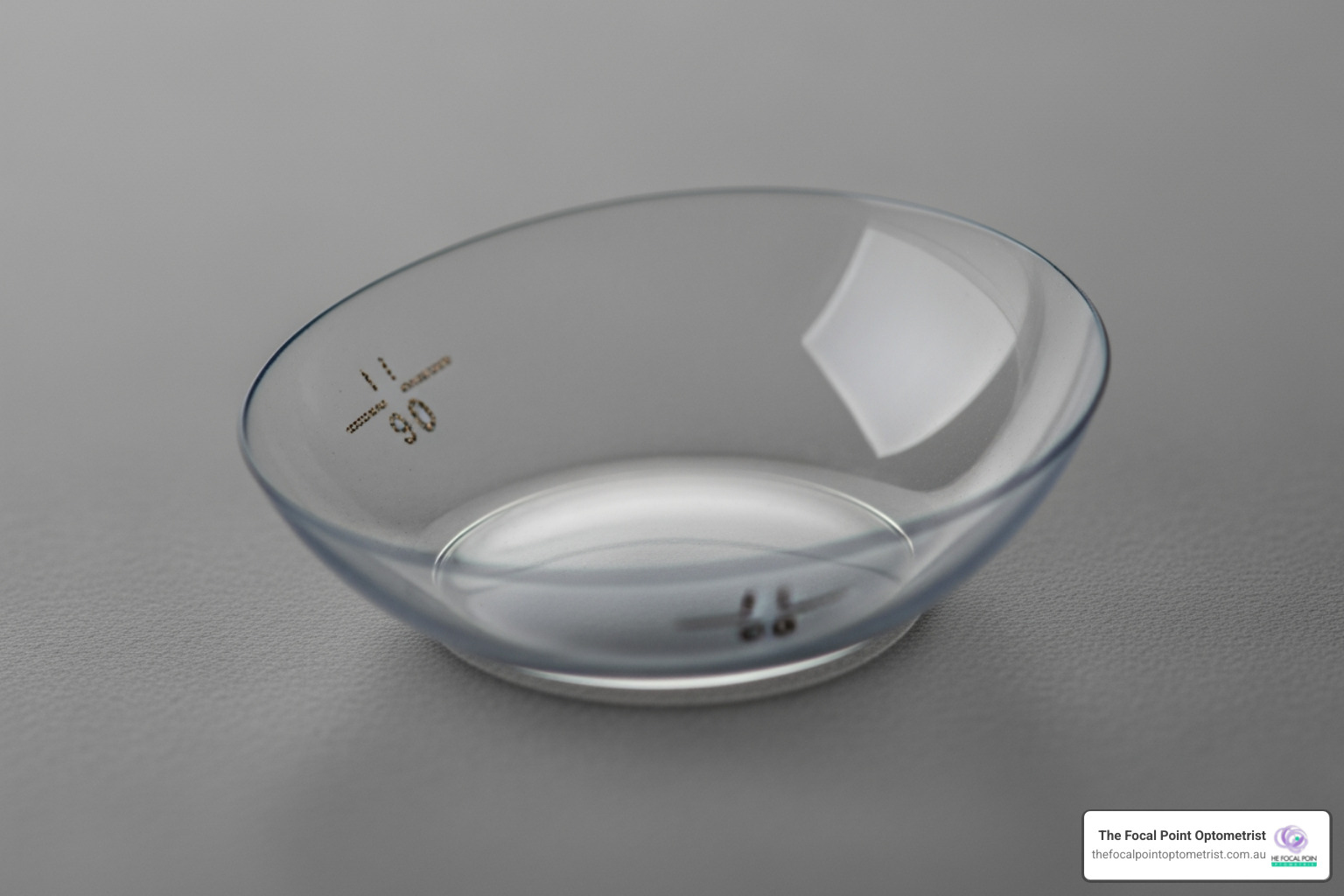
Yes, you can absolutely wear contact lenses with astigmatism! The advancements in contact lens technology over recent years mean that most people with astigmatism can enjoy the freedom and clear vision that contact lenses offer. Gone are the days when astigmatism meant you were limited to spectacles. Today, a wide range of specialised lenses is available, designed specifically to correct the unique shape of an astigmatic eye.
At The Focal Point Optometrist, we understand that finding the right contact lens solution for your astigmatism can be life-changing, offering a wider, unobstructed field of view and convenience for an active lifestyle. We take the time to understand your needs and find the perfect fit. For more information on our contact lens services, please visit our dedicated page: More info about our contact lens services.
What are Toric Contact Lenses and How Do They Work?
The primary type of contact lens used to correct astigmatism is called a toric contact lens. Unlike standard spherical contact lenses that have the same focusing power across the entire lens (like a slice of a basketball), toric lenses are designed with different focusing powers in different meridians. This unique design accounts for the unusual curvature of an astigmatic eye.
Imagine your eye’s surface is like a rugby ball. A standard lens can only correct vision along one curve of the rugby ball. A toric lens, however, has different curvatures in different directions, allowing it to correct the varying refractive power across your astigmatic cornea.
A critical feature of toric lenses is their design for stability. To work effectively, a toric lens must maintain a specific orientation on your eye. Manufacturers achieve this in several ways:
- Weighting: Some lenses have a slightly thicker or weighted zone at the bottom to help them settle into the correct position with gravity.
- Prism ballast: A prism-shaped thickness in the lens helps it rotate into the proper alignment.
- Truncation: The bottom edge of the lens may be slightly cut off to prevent rotation.
- Eyelid stabilisation: Some designs interact with your eyelids during blinking to keep the lens stable.
These design elements ensure the lens stays aligned on your eye, providing consistent, clear vision. Toric lenses can correct astigmatism, whether you are also short-sighted (myopia) or long-sighted (hyperopia), often combining the astigmatic correction with the spherical power needed for your short-sightedness or long-sightedness in a single lens.
Other Specialty Contact Lenses for Astigmatism
While soft toric contact lenses are the most common choice, especially for mild to moderate astigmatism, we have other excellent specialty options available, particularly for higher or more complex forms of astigmatism. These include:
- Rigid Gas Permeable (RGP) Lenses: These lenses are made from durable, oxygen-permeable plastic and are more rigid than soft lenses. RGP lenses maintain a stable shape on the eye, effectively replacing the elongated corneal surface with their own perfectly smooth optical surface. The tear film that forms between the RGP lens and your cornea helps to neutralise the astigmatism, often providing exceptionally crisp and stable vision, especially for higher amounts of astigmatism or stretched corneal shapes.
- Hybrid Lenses: As the name suggests, hybrid lenses combine the best of both worlds. They feature a rigid gas permeable centre for sharp vision, surrounded by a soft lens skirt for improved comfort. This design can be an excellent option for individuals who need the clarity of an RGP lens but prefer the comfort of a soft lens, particularly if they have moderate to high astigmatism or a history of discomfort with RGPs.
- Scleral Lenses: These are large-diameter RGP lenses that vault entirely over the cornea and rest on the sclera (the white part of your eye). The space between the lens and the cornea is filled with a preservative-free sterile saline solution, creating a smooth optical surface that effectively corrects even very high or uneven astigmatism, including conditions like keratoconus. Scleral lenses offer exceptional comfort and stable vision, often providing a significant improvement for patients who have struggled with other lens types.
Each of these specialty contacts is recommended based on the unique characteristics of your eye, the severity and type of your astigmatism, and your lifestyle needs. We will conduct a thorough eye test and fitting to determine which option will provide you with the best vision and comfort. You can find more detailed information about these advanced options on our page: More info about Toric Contact Lenses for Astigmatism.
Can I Wear Coloured Contacts with Astigmatism?
Yes, you can wear coloured contacts even if you have astigmatism! However, the selection may be more limited compared to standard coloured contact lenses, and the manufacturing process is more complex.
Coloured toric contacts combine the specific corrective powers of a toric lens with the aesthetic appeal of a coloured tint. Because toric lenses need to maintain a precise orientation on your eye for clear vision, the coloured portion must also be carefully integrated into this design. This adds to the complexity and cost of production, which means fewer colour options might be available from manufacturers.
The importance of a professional fitting is even more crucial with coloured toric lenses. Not only do we need to ensure the lens provides optimal vision correction and comfort, but we also need to check that the colour portion sits correctly and looks natural on your eye. A poorly fitting coloured toric lens could rotate, causing both your vision to blur and the coloured tint to appear off-centre, which isn’t ideal for either vision or appearance. We can help you explore available options if you’re interested in cosmetic lenses that also address your vision needs.
Advanced Contact Lens Options for Astigmatism and Myopia
For those of us managing both astigmatism and short-sightedness (myopia), especially in a progressive way, there are particularly exciting advanced contact lens options that go beyond simple correction. These lenses not only provide clear vision but can also play a role in managing the progression of myopia.
Orthokeratology (Ortho-K) for Myopia Management
Orthokeratology, or Ortho-K, is a fantastic option for individuals with astigmatism who also have short-sightedness and wish to be free from spectacles or contact lenses during the day. Ortho-K involves wearing specially designed rigid gas permeable lenses overnight. While you sleep, these lenses gently and temporarily reshape the front surface of your cornea. When you wake up, you remove the lenses and enjoy clear vision throughout the day without the need for any corrective eyewear.
The beauty of Ortho-K for astigmatism is that the unique design of the lens can be customised to neutralise both your short-sightedness and your astigmatism. This provides excellent visual clarity and freedom during your waking hours.
Furthermore, Ortho-K is a leading strategy in myopia management. For children and teenagers, wearing Ortho-K lenses overnight has been shown to slow down the progression of short-sightedness. This is crucial because high levels of myopia can increase the risk of serious eye conditions later in life. Myopia management involves personalised strategies and lifestyle changes, and Ortho-K is a non-surgical, reversible way to help reduce this risk. It’s not a one-size-fits-all approach, and we tailor the treatment to each individual’s needs.
We offer comprehensive Ortho-K services in Wembley, Perth, and Western Australia. If you’re interested in learning more about how Ortho-K can benefit you or your family, especially for managing myopia, please visit our page: Short-sighted contact lenses for myopia management.
Toric Multifocal Lenses
As we get older, usually around our mid-40s, many of us start to experience presbyopia – the natural age-related loss of our eyes’ ability to focus on close-up objects. If you also have astigmatism, this can mean juggling multiple pairs of spectacles or struggling with vision at different distances.
Enter toric multifocal lenses. These innovative contact lenses are designed to correct both your astigmatism and your presbyopia in a single lens. They have different power zones for distance, intermediate, and near vision, carefully integrated into the toric design that corrects your astigmatism. This means you can enjoy clear vision across all distances – whether you’re driving, working on a computer, or reading a book – all through one comfortable contact lens.
Toric multifocal lenses represent a sophisticated solution for complex vision needs, offering a high degree of visual freedom and convenience for individuals managing multiple refractive errors. We can discuss if these advanced lenses are suitable for your specific vision profile during your eye test.
Getting the Perfect Fit: Your Comprehensive Eye Test
Achieving optimal vision and comfort with astigmatism and contacts hinges entirely on getting the perfect fit. This is why a professional, comprehensive eye test and contact lens fitting are absolutely essential, especially for astigmatism. It goes far beyond simply getting a standard script.
At The Focal Point Optometrist, we pride ourselves on our meticulous approach. We never rush our patients, ensuring every detail is considered to find the ideal contact lens solution for your unique eyes. Our highly qualified team uses advanced technology to precisely measure and map your eyes.
A crucial part of this process is corneal topography. This involves using a specialised instrument to create a detailed, three-dimensional map of the curvature of your cornea. This map shows us the exact shape and any anomalies on your eye’s surface, which is vital for selecting the correct toric lens parameters, including the specific axis and power needed for your astigmatism.
Once we have these precise measurements, we’ll often proceed with a diagnostic lens trial. This means we’ll place trial lenses directly on your eyes in the clinic. This allows us to:
- Assess fit: We observe how the lens sits on your eye, how it moves with your blinks, and whether it maintains its stable orientation. A well-fitting toric lens will align correctly and consistently.
- Evaluate comfort: We want to ensure the lens feels comfortable for you from the moment it’s inserted.
- Check vision: We’ll test your vision with the trial lenses to confirm that you’re achieving the sharpest, clearest vision possible.
After the initial fitting, we’ll provide you with instructions on how to wear and care for your new lenses, and often send you home with a trial pair. Follow-up care is just as important as the initial fitting. We’ll schedule appointments to check how you’re adapting to the lenses in your daily life, make any necessary adjustments, and ensure your eyes remain healthy. Toric lenses should be rechecked at least annually by your optometrist before renewing your script. This thorough process ensures that your contact lenses are not only comfortable but also provide consistently clear vision and maintain your long-term eye health.
Comparing Contacts and Glasses for Astigmatism
Choosing between contact lenses and spectacles for astigmatism often comes down to personal preference and lifestyle. Here’s a quick comparison to help you weigh the options:
| Feature | Contact Lenses for Astigmatism (Toric) | Spectacles for Astigmatism |
|---|---|---|
| Field of View | Wider, unobstructed peripheral vision. No frames to get in the way. | Field of view is limited by the size and shape of the frames. Can cause some peripheral distortion. |
| Convenience for Active Lifestyles | Ideal for sports and active pursuits. They don’t slip, fall off, or get in the way. | Can be cumbersome during sports. They can slip, fog up, or break. |
| Weather Impact | Unaffected by rain or fogging up in changing temperatures. | Can get wet in the rain and fog up when moving from cold to warm environments, obscuring vision. |
| Maintenance & Cost | Require daily cleaning and disinfection (unless using dailies). Ongoing cost for lenses and solutions. | Easier to clean. Higher initial cost, but can last for years, potentially making them more cost-effective over time. |
| Vision Stability | Modern toric lenses are very stable, but can occasionally rotate, causing temporary blurriness. | Provide perfectly stable and consistent vision as the lenses are fixed in place. |
Frequently Asked Questions about Astigmatism and Contacts
We understand that navigating contact lens options for astigmatism can bring up many questions. Here are some of the most common queries we receive, along with our expert answers.
Are contacts or glasses better for correcting astigmatism?
This is a fantastic question and one we hear often! The truth is, there’s no single “better” option; it often comes down to personal preference, lifestyle, and the specifics of your astigmatism.
- Spectacles: Spectacles provide a very stable correction for astigmatism. Since the lens is fixed in the frame, it doesn’t move, ensuring consistent visual clarity. For some, especially those with very high astigmatism or certain underlying conditions, spectacles might initially feel like they offer superior vision.
- Contact Lenses: Modern contact lenses for astigmatism, particularly advanced toric designs, offer exceptional clarity and many benefits that glasses cannot. They provide an unobstructed, wider field of view, which is great for sports and active lifestyles. They also eliminate issues like fogging up in humid weather or getting wet in the rain. While older toric designs sometimes rotated on the eye with blinking, newer lenses have significantly improved stability and comfort.
Both options can provide excellent vision. Many of our patients choose to have both – wearing contact lenses for activities and spectacles for relaxing at home or as a backup. During your eye test, we can discuss your lifestyle and visual needs in detail to help you decide which option, or combination, is best for you. For more insights on this topic, you might find this article helpful: Which Is better for astigmatism — glasses or contacts?.
What are the special care instructions for astigmatism and contacts?
Proper care and hygiene are paramount for all contact lens wearers, but especially important for those with astigmatism, as maintaining lens integrity and cleanliness directly impacts vision stability and eye health. Here are our key recommendations:
- Hand Hygiene is Non-Negotiable: Always wash your hands thoroughly with soap and water and dry them completely with a lint-free towel before handling your contact lenses. This prevents the transfer of bacteria and debris to your eyes.
- Correct Insertion Technique: Toric lenses have specific orientation markings. While many modern lenses are designed to settle correctly, it’s good practice to ensure they are inserted in the correct orientation. We will show you how to identify these markings and insert your lenses properly during your fitting.
- Use Recommended Solutions Only: Always use the contact lens solution prescribed or recommended by us. Different lens materials require specific solutions. Never mix solutions or use expired products. For scleral or RGP lenses, you’ll need specific cleaners, conditioning solutions, and preservative-free sterile saline for filling scleral lenses.
- Never Use Tap Water: This is a critical rule! Tap water, even filtered water, contains microorganisms that can cause severe eye infections. Never rinse, store, or clean your contact lenses with tap water. Avoid showering or swimming with your lenses in unless they are daily disposable lenses that you discard immediately after water exposure.
- Adhere to Replacement Schedules: Whether you wear daily, bi-weekly, or monthly disposable lenses, stick strictly to the recommended replacement schedule. Over-wearing lenses can lead to deposit buildup, discomfort, reduced oxygen flow to the eye, and increased risk of infection.
- Clean and Replace Your Lens Case Regularly: If you use reusable lenses, clean your lens case daily with fresh solution and allow it to air dry. Replace your lens case every one to three months to prevent bacterial buildup.
- Don’t Sleep in Lenses (Unless Approved): Only certain types of toric lenses are approved for extended (overnight) wear. Sleeping in lenses not approved for this purpose significantly increases your risk of serious eye infections. We generally recommend daily removal whenever possible to keep your eyes as healthy as can be.
- Recognise and Act on Symptoms: If you experience persistent blurry vision, eye redness, pain, excessive tearing, or discharge, remove your lenses immediately and contact us. Do not try to “tough it out” or self-diagnose.
By following these care instructions diligently, you can ensure your eyes remain healthy and your vision stays clear and comfortable with your astigmatism contact lenses.
Can I wear a non-toric contact lens if my astigmatism is mild?
This is a common question, and while it might seem like a simpler option, we generally advise against it for optimal visual clarity and comfort.
In some very specific cases, if your astigmatism is extremely mild (typically less than one dioptre), a standard spherical or aspheric contact lens might provide acceptable vision for some daily activities. However, it’s crucial to understand that your vision would not be completely corrected. This means you might still experience some blurriness, especially for tasks that require sharp focus, like night driving or computer work. Your eyes might also have to work harder to compensate, leading to potential eye strain or headaches.
The purpose of correcting astigmatism is to ensure light focuses precisely on your retina. A non-toric lens simply doesn’t have the unique design required to do this for an astigmatic eye. Even if your astigmatism is mild, a toric lens is specifically engineered to provide that crisp, clear vision you deserve. We’ve found that many people with mild astigmatism still benefit significantly from toric correction, experiencing a noticeable improvement in visual quality compared to spherical lenses.
We would always recommend a professional assessment to determine the best approach. Relying on non-toric lenses for astigmatism, even mild cases, can lead to compromised vision, discomfort, and potentially mask other issues. It’s always best to discuss this with us during your eye test. For more information, you can also refer to this resource: Can I wear contact lenses without astigmatic correction?.
Your Next Steps to Clearer Vision
We’ve covered a lot about astigmatism and contacts, from understanding the condition to exploring the array of modern contact lens solutions available. It’s clear that astigmatism no longer means you’re limited to spectacles. With advanced toric lenses, specialty options like RGPs, hybrids, and sclerals, and even innovative myopia management solutions like Ortho-K, the possibilities for clear, comfortable vision are extensive.
At The Focal Point Optometrist, we believe that vision is more than just sight; it involves your eyes teaming, focusing, and moving efficiently, all working seamlessly with your brain. This holistic understanding guides our approach to your eye care. We are experienced and caring optometrists who provide behavioural vision care, focused on prevention and treatment of vision problems, and how vision impacts human behaviour and performance.
Our independent practice in Wembley, Perth, isn’t just a retail shop; we are a dedicated healthcare provider. Our team of highly qualified optometrists takes the time to understand your unique visual needs and lifestyle, never rushing you through an appointment. We use advanced technology to provide comprehensive eye tests and fittings, ensuring you receive the most accurate and personalised solution.
If you suspect you have astigmatism, or if you’re experiencing any vision discomfort with your current correction, it’s time to take the next step. We’re here to guide you through the process, helping you find the best solution for your eyes and your lifestyle.
Book your comprehensive eye test with us today to open up your clearest, most comfortable vision.