
Why Can’t I Wear One Pair of Glasses for Everything? Discover the Benefits of Task-Specific Eyewear
One pair of glasses can work well for many everyday moments, but it may not give the most comfortable vision for every task. Different activities place different demands on your eyes, especially when you move between distance viewing, screen work, reading, driving, and bright outdoor conditions.
A general-purpose pair of spectacles has to balance several focal distances within one lens design. That balance can be practical, but it also means some viewing zones may be narrower or less comfortable than lenses designed for one main activity.
Task-specific eyewear can support clearer, more relaxed vision by matching the lens design to how you actually use your eyes. Office lenses, driving lenses, script sunglasses, and a backup pair each solve a different practical problem.
The right eyewear combination depends on your script, work setup, hobbies, driving habits, and sensitivity to light. A thoughtful eye test can help identify where one pair is doing enough and where a second pair may make daily vision feel easier.
Key Takeaways
- Multi-pair optical solutions can support comfortable posture and ergonomic alignment across different focal distances.
- Task-specific lenses can help reduce accommodative strain during extended screen and office work.
- Dedicated specialised sunglasses provide targeted UV protection and effective glare reduction.
- Secondary frames ensure continuous clear vision as a supportive and practical backup option. Explore our full range of tailored vision options through our comprehensive Eye Care Services.
Visual focal lengths, ambient lighting, screen distances, and head posture differ dramatically between daily activities. Distance viewing requires broad spatial clarity, while digital display work places continuous focusing demands on intermediate visual zones, potentially straining your visual system when relying on standard single-pair lenses.
Building a versatile eyewear wardrobe allows task-specific lenses to complement your primary frames. By choosing targeted options from our range of quality Adult Glasses and versatile Glasses, you can support visual comfort, encourage healthy ergonomic alignment, and help manage daily eye fatigue.
The Hidden Challenges of Relying on a Single Pair
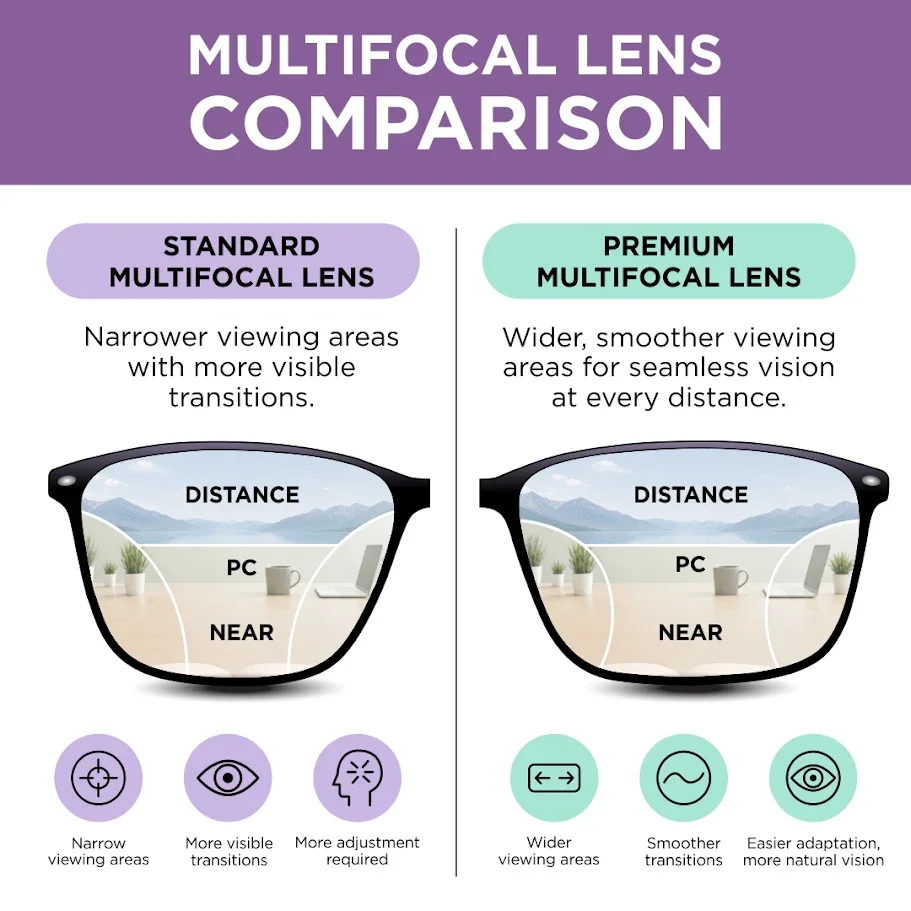
Multifocal and progressive lenses are useful optical tools designed to provide clear vision across multiple distances in a single lens profile. By combining distance, intermediate, and near optical corrections into one continuous gradient, progressive lenses allow wearers to shift their focus from distant objects to a dashboard and down to a mobile phone without changing spectacles.
However, combining three distinct optical zones into a single frame requires design balance. Because a progressive lens transitions smoothly from distance vision at the top to reading vision at the bottom, the intermediate visual zone in the middle of the lens is naturally restricted. This intermediate corridor is narrower than the top or bottom portions of the lens, creating small areas of mild peripheral softness on either side.
For presbyopes who need help with near focus as part of natural age-related vision changes, progressive lenses remain a versatile everyday choice. Understanding how these lenses function can help set reasonable expectations for their daily performance. For a broader overview of how progressive optics manage age-related near-focus changes, you can explore our detailed A-Z Guide to Multifocal Spectacle Lenses and our practical Beginner’s Guide to Presbyopia.
Optical Compromises
Relying on a single general pair can introduce unexpected visual compromises when your daily routine includes long periods at different working distances. Standard general-purpose spectacles are not always designed to support prolonged intermediate demands for hours at a time. Over extended periods, this continuous focusing demand can lead to visual fatigue, often recognised as digital strain or Computer Vision concerns, and may unmask underlying Accommodative Difficulties that go unnoticed during brief daily tasks.
Multifocals can also feel awkward in ordinary relaxed positions, not just during formal work tasks. If you are kicking back on the couch watching television, your head and eyes may naturally angle through the intermediate corridor rather than the distance portion of the lens, making the screen feel less clear or less settled. A similar issue can happen on an aeroplane, where the entertainment screen is often positioned higher than a book or phone. Looking through a full multifocal in that posture may place the screen in the wrong lens zone, so you may need to adjust your chin, seat position, or spectacles to find a clearer view.
Matching Lenses to Daily Tasks
Eyewear works best when the lens design reflects how you use your eyes throughout the day. Screen distance, desk height, reading position, outdoor light, and driving conditions all affect how comfortable a pair of spectacles feels. A pair designed mainly for general use may be adequate for short tasks, but it may feel limiting when one activity dominates your day.
Consistency in Visual Comfort Across Tasks
Maintaining consistent visual clarity throughout your day requires matching the right optical design to each specific task. While general-purpose progressive lenses perform well for general movement and short viewing tasks, using them continuously for long hours at a desktop screen may cause physical adjustments. Wearers often find themselves tilting their head upward to align with the intermediate corridor of the lens, which may lead to physical tightness over time.
Supporting Long-Term Visual Health
Taking care of your vision involves more than correcting refractive error; it involves protecting your visual system from unnecessary strain and environmental exposure. Using task-tailored spectacles can support comfortable binocular visual alignment and help cushion your eyes against excessive accommodative effort. Protecting your ocular health also involves managing ambient light and solar UV exposure with targeted lens options.
What to Expect During an Eye Test
During your eye test, your optometrist will evaluate your distance visual acuity, near focusing stability, spatial alignment, and overall eye health. If you are experiencing discomfort, you are welcome to Book an Eye Test or get in touch via our Contact Us page to discuss your options.
Practical Solutions: How Specialised Lenses Enhance Comfort for Work, Driving, and Outdoors
Rather than forcing a single pair of spectacles to manage every task, task-specific optical designs cater directly to particular activities. By selecting dedicated specialised lenses tailored to your primary work, driving, or outdoor habits, including prism where relevant to support binocular visual alignment, you can reduce optical compromises and offer your eyes targeted support.
The table below highlights how task-specific lens designs compare to standard progressive lenses and traditional single vision reading glasses across key daily visual demands:
| Lens Type | Distance Field | Intermediate Field | Near Field | Ergonomic Posture | Ideal Primary Use Case |
|---|---|---|---|---|---|
| Standard Progressive | Wide & Clear | Restricted / Narrow Corridor | Moderate Width | May require head tilting for screens | General everyday wear, moving between tasks |
| Office / Computer | Minimal to None | Exceptionally Wide | Broad & Relaxed | Supports natural, upright head position | Desk work, multi-monitor setups, indoor hobbies |
| Specialised Driving | Maximum Panorama | Moderate & Clear | Functional | Supports neutral head posture | Night driving, long road trips, variable light travel |
| Single Vision Readers | Blurred at distance | Blurred at Screen Distance | Broad Focal Zone | Natural for books, limited for screens | Close-up reading (30-40cm), fine handcrafts |
Through our comprehensive range of Eye Care Services, our optometrists carefully evaluate your occupational setup, driving habits, and leisure routines to recommend the ideal combination of specialised spectacle options.
What Are Office and Computer Lenses, and How Do They Function?
Office and computer lenses (occupational progressives) are built specifically to address the intermediate field limitation of standard progressive lenses. Instead of prioritising distance clarity at the top of the lens, office lenses devote their largest visual area to intermediate distances (such as computer monitors, laptop displays, and desktop surfaces) while retaining a comfortable lower zone for close reading.

By widening the intermediate viewing zone, office lenses allow you to view dual monitors, reference documents, and converse across a desk without tilting your chin upward or turning your head side-to-side to search for a narrow clear window. Specialised office optics, including prism where relevant for binocular alignment, support a natural, upright head position, which can help reduce neck and shoulder muscle tightness.
In addition to tailored focal profiles, modern office lenses can be enhanced with specialised anti-reflective coatings designed to manage bright reflections and artificial lighting glare. When working under intense indoor light panels, these coatings help filter out harsh reflections, supporting sustained visual comfort throughout your workday.
Why Are Dedicated Script Sunglasses Necessary Beyond Light-Reactive Lenses?
While light-reactive (transition) lenses offer convenient automatic light adaptation when walking outdoors, dedicated sunglass frames provide distinct advantages. Because modern automotive windscreens are manufactured with UV-blocking laminated glass, light-reactive lenses may not darken fully inside a car during daytime driving.
Dedicated outdoor Script Sunglasses use permanently tinted optical lenses, often paired with high-performance polarising filters. Polarisation acts to filter out severe horizontal glare reflected from wet asphalt, open highways, water surfaces, and reflective vehicle body panels.
Beyond visual comfort, wearing high-grade sunglass lenses plays a vital role in supporting long-term ocular health. According to the Cancer Council NSW, prolonged exposure to solar UV radiation is a recognised risk factor for structural changes on the surface of the eye, premature cataract development, and retinal changes. Protecting your visual system with quality sunglasses helps safeguard your sight across every season. You can discover more about protecting your visual health outdoors by browsing our informative collection on All About Vision.
Why Is Having a Secondary or Backup Pair Essential for Vision Management?
Relying entirely on a single pair of spectacles creates a potential vulnerability in your daily routine. If your sole pair of glasses is accidentally dropped, misplaced, or damaged, your ability to drive safely, perform work duties, or manage daily routines can be abruptly interrupted. Having a secondary pair ensures continuity and peace of mind.
For wearers of Contact Lenses, maintaining an up-to-date secondary pair of spectacles is essential for supporting general ocular surface wellness. Removing contact lenses in the evening and switching to a supportive pair of spectacles allows the cornea to rest and rehydrate naturally. Additionally, if temporary eye irritation or seasonal sensitivities arise, pausing contact lens wear and using current spectacles allows your eyes time to recover comfortably.
Should You Reuse Your Old Frames for New Lenses?
When updating your spectacle script, it can be tempting to keep a favourite older frame and ask to have new lenses fitted into it. While this seems convenient, fitting new lenses into aged frames carries practical risks.
Over time, frame materials undergo subtle degradation. Acetate materials can lose flexibility and become brittle, while metal frames may experience stress along join points and rim wires. When an optical laboratory inserts new lenses into an older frame under pressure, the frame may fracture.
Instead of re-lensing an older frame, a reliable approach is to keep your complete former spectacles intact as a secondary pair. Storing your former pair in a glove box, office desk, or travel case ensures you always have a functional backup ready if your primary glasses require adjustment or repair.
Signs That Your Current Glasses May Be Causing Visual Fatigue
Many individuals tolerate mild visual discomfort during the day, assuming it is an inevitable result of spending extended periods in front of digital displays. However, persistent visual fatigue often indicates that your current single pair of glasses is being asked to perform tasks outside its optimal design profile.
Key signs that your current spectacles may be contributing to visual strain include:
- End-of-day forehead tightness: Frequent aching around the eyes or forehead after working or driving.
- Neck and shoulder stiffness: Muscle tightness caused by tilting your head or leaning forward to bring displays into focus.
- Fluctuating vision clarity: Moments where text on a screen appears temporarily blurred, requiring extra effort to refocus.
- Watery or tired eyes: Discomfort caused by reduced blink frequency during prolonged visual concentration.
- Increased light sensitivity: Discomfort when moving between indoor and outdoor light, or when facing night traffic.
- Visual fatigue while reading: Feeling sleepy or losing your place on a page after short reading sessions.
If you notice these signs, conducting a personal lifestyle audit can be helpful. Consider how many hours you spend using digital screens, how frequently you drive at night, and what hobbies require dedicated close vision. When you are ready to evaluate your visual comfort, you can easily Book an Eye Test online or reach out directly through our Contact Us page.
During a consultation at our practice, your optometrist can perform targeted assessments, including Binocular Vision Testing, to evaluate how effectively your eyes work together and adjust focus. To learn more about what occurs during a visual assessment, feel free to read our guide on Comprehensive Eye Test 101.
Frequently Asked Questions About Owning Multiple Pairs of Glasses
Can I Just Use Ready-Made Reading Glasses for Computer Work?
Ready-made reading glasses available at retail stores are designed as simple magnifiers rather than customised optical solutions. They feature equal power in both lenses and use a fixed optical centre that may not align with your unique pupillary distance (PD).
Using non-script magnifiers for extended screen tasks can increase visual discomfort. Because they lack your exact script, cannot correct for astigmatism, and are calibrated for close reading distances rather than computer distances, non-script magnifiers may force your eye muscles to work harder to maintain clear focus. Over time, this mismatch can contribute to visual strain.
How Often Should I Schedule an Eye Test to Review My Script?
To ensure your spectacles continue to support your eyes comfortably, routine visual evaluation is essential. For healthy adults, scheduling regular Eye Tests every two years is generally recommended to monitor subtle vision changes and screen for underlying ocular health considerations.
However, individuals with established health conditions such as diabetes or high blood pressure, or those with specific ocular monitoring needs, should undergo evaluation as advised by their optometrist to monitor health and update scripts promptly. Regular review helps maintain clarity and physical comfort.
Do I Need Multiple Pairs If I Only Wear Single Vision Lenses?
Even if you do not require multifocal or progressive lenses, single-vision wearers often benefit from task-specific eyewear. A single-vision script tailored for distance clarity will not reduce solar glare, nor will it lessen headlight reflections during night driving.
Single-vision wearers who spend extended periods working on desktop computers frequently find that dedicated single-vision office lenses (calibrated for their screen distance with anti-reflective coatings) offer significantly more relaxed visual comfort than using standard distance glasses at a computer desk.
Finding Clarity and Ease with Eyewear Tailored to You
Expecting a single pair of glasses to handle bright outdoor sunlight, intensive computer work, road driving, and evening reading without compromise is a demanding task. Visual requirements change throughout your daily routine, and matching the right optical design to each activity can support healthy posture, cushion visual effort, and assist long-term eye health.
At The Focal Point Optometrist, we believe in a warm, attentive, and highly personalised approach to vision care. As an independent practice, our focus is entirely on understanding your daily routine, workplace environment, and visual comfort. We position our initial consultations as approximately one hour to ensure you feel properly seen and heard. This dedicated time allows us to carefully assess how your eyes work together so we can design a tailored eyewear wardrobe that fits your lifestyle seamlessly.
Whether you are seeking relief from workstation postural strain with specialised office lenses, looking for high-performance script sunglasses, or wishing to establish a reliable secondary pair as a backup, our experienced team is here to support you. Please remember to bring your Medicare card along to your appointment so we can assist you smoothly.
Take the next step toward comfortable visual clarity across all your daily activities. Learn more about our practice philosophy at The Focal Point Optometrist, connect with our friendly team via our Contact Us page, or conveniently Book an Eye Test online today.