Visual Snow Syndrome: Symptoms, Causes, and Management for Better Visual Comfort
Visual Snow Syndrome is a neurological visual processing condition where a person sees continuous tiny flickering dots across the whole visual field, often compared with television static. It is usually discussed alongside symptoms such as afterimages, light sensitivity, difficulty seeing in low light, and heightened awareness of normal internal visual phenomena. Management focuses on careful assessment, ruling out ocular or neurological concerns, and supporting visual comfort through options such as specialised chromatic filters, visual ergonomics, and neuro-optometric strategies where appropriate.
Key Takeaways
- Neurological Basis: Visual Snow Syndrome involves altered central sensory processing and cortical hyperexcitability rather than physical ocular disease.
- Primary Symptoms: Features continuous, pan-field visual static alongside symptoms such as palinopsia (afterimages), photophobia, nyctalopia, and enhanced entoptic phenomena.
- Multidisciplinary Assessment: A dedicated evaluation rules out structural ocular and neurological concerns while assessing functional vision.
- Management Pathways: Neuro-optometric rehabilitation, visual ergonomics, and specialised chromatic filters can support daily visual comfort for some people.
When navigating unusual visual disturbances, experiencing consultations where your symptoms are minimised can feel deeply isolating. Many individuals who experience persistent visual static spend months or years searching for clear answers, often feeling dismissed when routine eye health checks show normal ocular structures. A thorough assessment helps ensure complex sensory symptoms are carefully evaluated in context.
Living with persistent visual noise can impact daily visual tasks, reading comfort, night driving, and overall well-being. Because the brain’s internal sensory gating mechanisms are altered, individuals frequently experience heightened sensitivity to light, afterimages, and co-occurring non-visual sensory disturbances. A dedicated comprehensive eye test allows an optometrist to evaluate ocular health, rule out underlying structural disease, and assess binocular coordination thoroughly.
Clinical Assessment Priorities for Visual Static
A careful assessment for persistent visual static focuses on understanding the full pattern of symptoms, checking ocular health, and identifying whether functional visual factors are adding to daily discomfort. Standard visual acuity testing may show clear 6/6 vision, yet it does not explain how the visual cortex filters background sensory noise. This is why the clinical history, symptom duration, visual field pattern, light sensitivity, afterimages, and low-light function all need to be considered together.
When ocular structures appear healthy, the next step is not to dismiss the concern, but to distinguish between central visual processing symptoms, transient migraine phenomena, and eye health issues that require referral. A structured optometric assessment can review retinal health, binocular coordination, focusing stamina, glare sensitivity, and visual comfort during near tasks. This gives patients a clearer care pathway while supporting appropriate collaboration with General Practitioners (GPs), neurologists, or neuro-ophthalmologists when symptoms are new, atypical, or medically concerning.
The Personalised Neuro-Optometric Experience
A personalised consultation is designed to give you ample time to share your experiences without feeling hurried. Initial consultations at an independent practice are positioned as approximately one hour, providing a dedicated space where every visual symptom can be explored in detail. Feeling properly seen and heard forms the foundation of effective neuro-optometric care.
During a tailored evaluation, an optometrist reviews your visual history, evaluates binocular function, and investigates how light sensitivity, glare, and afterimages affect your day-to-day visual tasks. Understanding how eye coordination impacts daily tasks is vital, making it worthwhile to review everything you need to know about binocular vision disorders to explore how binocular teaming influences comfort.
As outlined in the Australasian College of Behavioural Optometrists guide to Visual Snow Syndrome, persistent static represents a central sensory processing difference rather than an isolated ocular disease. Clinical validation and tailored education help patients understand the neurological nature of their symptoms, reassuring them that their eyes remain structurally healthy.
Beyond constant visual static, affected individuals often notice enhanced entoptic phenomena, which are visual effects that arise from within the eye or visual pathways itself:
- Excessive blue field entoptic phenomenon: Uncountable tiny, bright dots moving rapidly along squiggly lines when looking at uniform bright surfaces like a clear blue sky.
- Self-lighting of the eye: Swirling clouds of colour, waves, or spontaneous light phosphenes perceived in total darkness or with closed eyelids.
- Photopsia: Spontaneous flashes of light, sparks, or shimmering bursts across the visual field.
Primary Visual Symptoms of Visual Snow Syndrome
A formal clinical evaluation considers a spectrum of co-occurring visual processing disturbances. Alongside the continuous static, four main visual symptom categories frequently appear:
- Palinopsia: The persistence or recurrence of visual images after the actual stimulus has been removed. This may present as positive afterimages (seeing a replica of an object immediately after looking away) or visual trailing (moving objects leaving a stuttered, frame-by-frame trail behind them).
- Photophobia: An increased sensitivity or visual intolerance to bright environments, digital screens, overhead fluorescent lighting, and glare.
- Nyctalopia: Impaired vision in low-light settings, where distinguishing objects in dim rooms or driving at night becomes strenuous because background visual static overwhelms low-contrast details.
- Enhanced Entoptic Phenomena: An inability of the central nervous system to suppress or filter out normal internal visual artefacts, causing them to appear amplified and intrusive.
Non-Visual Sensory Disturbances
Visual Snow Syndrome is increasingly understood as a broader sensory processing condition that extends well beyond sight. The central nervous system processes visual, auditory, and tactile signals concurrently, and disruptions in central sensory gating can produce a constellation of non-visual symptoms:
- Tinnitus: Constant or intermittent ringing, buzzing, humming, or high-pitched sound in the ears without an external auditory source.
- Hyperacusis: Heightened sensitivity to particular everyday sound frequencies, making normal environments uncomfortably loud.
- Brain Fog and Cognitive Fatigue: Slower mental processing, short-term memory challenges, and difficulty maintaining concentration during visually intensive tasks.
- Depersonalisation and Derealisation: A distressing sensation of being detached from one’s own body or feeling as though the surrounding environment is dreamlike, artificial, or distant.
- Paresthesia and Sensory Disturbances: Spontaneous tingling, “pins-and-needles” sensations in the extremities, or brief electrical shock-like sensations.
- Cutaneous Allodynia and Hyperesthesia: Heightened skin sensitivity where routine light touch, such as brushing hair or the gentle resting of spectacle frames on the nose, feels uncomfortable.
- Migraine Comorbidity: Frequent episodes of headache or migraine, which can occur with or without typical visual auras.
Underlying Mechanisms: What Causes Visual Static?
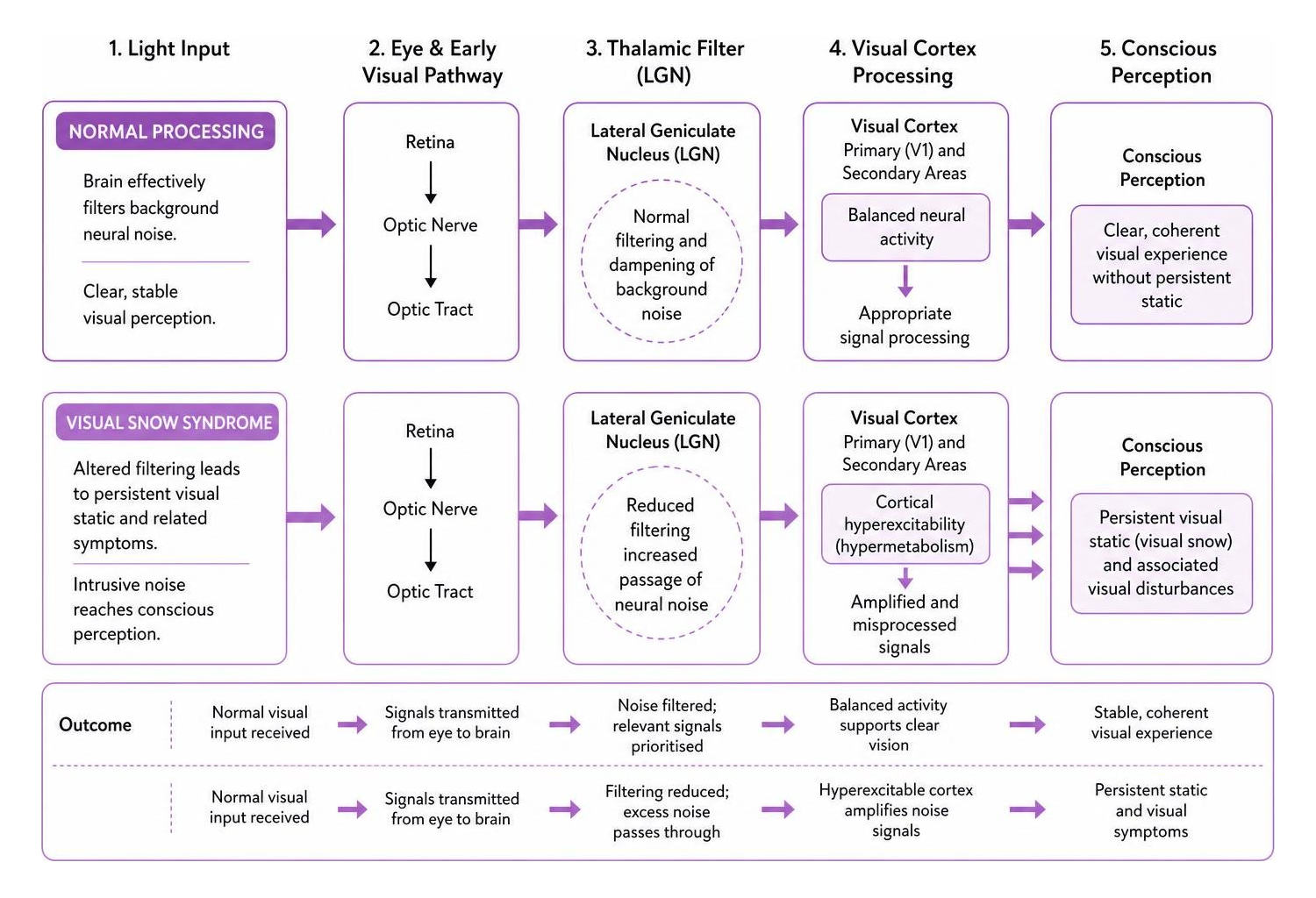
Contemporary neuroimaging and clinical research indicate that Visual Snow Syndrome is a distributed brain network condition rather than an ocular disorder. The primary issue lies in how the brain filters, modulates, and processes incoming sensory stimuli.
Under normal physiological conditions, the brain continuously dampens background neural noise so that a clear, stable picture reaches conscious perception. In individuals experiencing persistent visual static, this filtering mechanism is altered. Neuroimaging studies, including functional magnetic resonance imaging and positron emission tomography, have identified several key neurological factors:
- Cortical Hyperexcitability: Hypermetabolism and heightened neural responsiveness within the visual cortex, particularly the right lingual gyrus and secondary visual processing areas.
- Thalamocortical Dysrhythmia: Disrupted communication rhythms between the thalamus (the brain’s primary sensory relay station) and the cerebral cortex, leading to a failure in filtering out spontaneous background visual noise.
- Neurotransmitter Imbalances: Functional changes involving glutamatergic (excitatory) and serotonergic/GABAergic (inhibitory) signalling pathways, which regulate neural excitability across visual and limbic networks.
- Sensory Disinhibition: Reduced activity in filtering regions such as the insula and anterior cingulate cortex, leaving the brain susceptible to sensory overload.
Onset can occur spontaneously in childhood or develop later in life. In some cases, symptoms emerge following distinct triggers such as severe psychological stress, persistent migraine episodes, certain systemic medications, or head trauma. To explore how physical impact affects brain-eye communication, read the complete guide to vision and concussions.
Differentiating Static Vision from Migraine Aura and Ocular Pathology
Because visual disturbances can stem from different underlying causes, distinguishing between transient migraine phenomena, acute ocular pathology, and chronic visual static is essential during any clinical workup.
| Feature | Visual Snow Syndrome | Migraine Visual Aura | Retinal / Vitreous Pathology |
|---|---|---|---|
| Duration | Continuous 24/7 (lasting months or years) | Transient (typically 5 to 60 minutes) | Variable (sudden onset or persistent until managed) |
| Visual Field Extent | Entire visual field (pan-field) | Localised or expanding across one sector | Localised or peripheral quadrant |
| Appearance with Closed Eyes | Static and afterimages remain visible | Scintillating scotoma remains visible | Usually disappears or appears as dark shadows |
| Structural Eye Health | Normal ocular structures and retinas | Normal ocular structures | Structural changes on dilated fundus evaluation |
| Associated Non-Visual Symptoms | Chronic tinnitus, sensory overload, brain fog | Headache, nausea, photophobia (episodic) | None (strictly isolated to the eye) |
It is also important to differentiate pathological static from normal physiological dark noise, known as eigengrau. In complete darkness, photoreceptors naturally maintain intrinsic electrical activity, producing a faint, grainy grey perception. In Visual Snow Syndrome, however, the static is present across all lighting levels, including bright daylight, and is accompanied by additional visual processing symptoms.
To evaluate eye coordination, focusing, and structural health thoroughly, an optometrist may utilise dedicated binocular vision testing to distinguish central visual processing differences from underlying optical misalignments.
Consistency in Long-Term Care and Collaborative Support
Managing a chronic sensory processing condition requires consistency and continuity of care. When you see the same optometrist over time, you build a supportive relationship where subtle changes in your visual comfort, screen stamina, and binocular function can be tracked reliably. Continuity avoids the frustration of repeatedly explaining your visual history to different practitioners.
An experienced optometrist acts as a steady advocate, working collaboratively with General Practitioners (GPs), neurologists, and allied health professionals. When therapeutic treatments are indicated, they require assessment by a therapeutically endorsed optometrist. For conditions requiring specialist surgical or medical intervention, your optometrist will provide a timely referral to an ophthalmologist or General Practitioner (GP).
Protecting Long-Term Visual Health and Well-Being
While Visual Snow Syndrome is non-degenerative and does not cause physical damage to the eyes, protecting overall ocular and visual health remains essential. Individuals with visual static are still susceptible to routine refractive changes such as becoming short-sighted, long-sighted, or developing astigmatism. Addressing optical misalignments ensures that uncorrected refractive errors do not place extra strain on an already sensitive visual system.
Maintaining regular eye tests allows your optometrist to monitor internal and external ocular structures, ensuring the retinas and optic nerves remain healthy. This long-term monitoring provides peace of mind, reinforcing that while your brain processes visual information uniquely, your eyes remain healthy and robust.
What to Expect During a Dedicated Visual Assessment
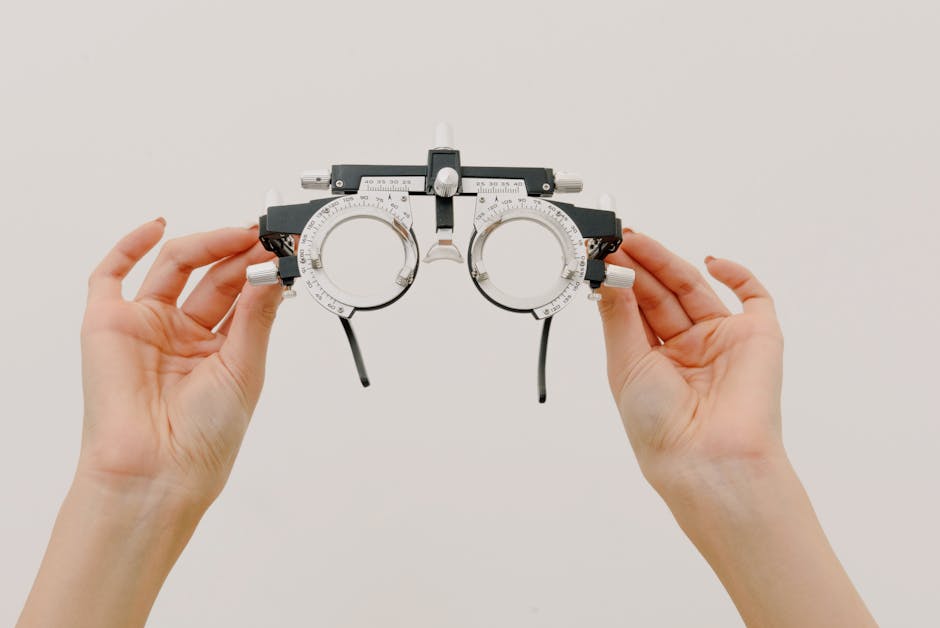
A comprehensive evaluation for persistent visual static involves a systematic approach: excluding structural ocular and intracranial pathology, confirming diagnostic criteria, and assessing functional binocular and oculomotor performance.
Because symptoms can mimic other conditions, an initial clinical workup involves thorough dilated fundus evaluation, automated visual field testing, and retinal imaging to verify structural integrity. If new or atypical neurological symptoms are present, referral to a neurologist or neuro-ophthalmologist for neuroimaging helps rule out conditions such as occipital seizures, demyelinating disease, or intracranial lesions.
During a neuro-optometric assessment, an optometrist evaluates how efficiently the visual system tracks, focuses, and aligns under varying visual demands. Assessing saccadic eye movements (rapid shifts between visual targets) and smooth pursuit tracking can reveal functional strain, which is detailed in the ultimate guide to eye tracking.
Clinical Assessment Criteria for Visual Snow Syndrome
In clinical practice, the established Schankin diagnostic criteria provide the framework for identifying the syndrome. An assessment typically considers the condition when the following criteria are met:
- Dynamic Visual Static: Fine, continuous dots across the entire visual field persisting for at least three months.
- Presence of at Least Two Additional Visual Symptoms:
- Palinopsia (afterimages or visual trailing)
- Enhanced entoptic phenomena (excessive blue field phenomenon, entoptic visual artefacts, or spontaneous flashes)
- Photophobia (glare intolerance and light sensitivity)
- Nyctalopia (difficulty distinguishing objects in dim light)
- Symptom Consistency: The visual static cannot be accounted for by typical migraine visual aura or another known ocular condition.
- Normal Clinical Baseline: Standard visual acuity, slit-lamp biomicroscopy, dilated ophthalmoscopy, and visual field testing demonstrate healthy ocular structures.
Evaluating accommodation and focusing flexibility is equally critical. For a deeper look into the physiological mechanics of focusing, see a comprehensive guide to how eyes focus.
Practical Management Pathways and Neuro-Optometric Support
While no single medication cures Visual Snow Syndrome, a supportive, multi-faceted management strategy can significantly ease visual discomfort, lower sensory overload, and support functional daily quality of life.
Management begins with clinical validation. Learning that the condition is benign, non-degenerative, and not a precursor to blindness often relieves considerable health-related stress. Beyond education, neuro-optometric strategies and lifestyle modifications play a practical role:
- Specialised Chromatic Filters: Precision-tinted spectacle lenses, such as FL-41 or customised colour filters, can help reduce cortical hyperexcitability. These specialised lenses absorb specific wavelengths of blue-green light, helping to alleviate photophobia, reduce glare from screens, and lessen visual static intensity.
- Visual Ergonomics: Modifying work environments by using warm, indirect lighting, matte screen protectors, and high-contrast digital display settings to lower sensory strain during near tasks.
- Stress Modulation and Sleep Support: Consistent sleep routines and mindfulness practices support central nervous system regulation, helping to minimise symptom flares.
- Multidisciplinary Coordination: Working in tandem with General Practitioners (GPs), neurologists, and mental health professionals to manage coexisting conditions such as migraine headaches, tinnitus, and anxiety.
For structured visual rehabilitation, exploring a comprehensive guide to vision therapy provides insight into how non-invasive programmes support neurological adaptation and visual comfort.
If you are experiencing persistent visual disturbances, please reach out to our team to Contact Us or Book an Eye Test for an evaluation.
Addressing Oculomotor and Focusing Difficulties
Clinical evaluations frequently reveal that individuals with visual static also experience coexisting oculomotor dysfunctions, including:
- Convergence Insufficiency: Difficulty coordinating both eyes inward when viewing nearby targets, leading to double vision or words moving on the page.
- Accommodative Insufficiency: Reduced stamina or flexibility in the eye’s natural focusing system, causing intermittent blur during extended near tasks.
- Saccadic and Pursuit Inaccuracies: Difficulty maintaining smooth tracking across text or moving objects, exacerbating visual fatigue.
Neuro-optometric visual rehabilitation therapy focuses on retraining eye teaming, accommodation, and spatial tracking. By improving the efficiency of the visual motor system, patients can reduce the physical effort required to process complex visual tasks, allowing the visual cortex to function with greater ease.
Navigating Static Vision with Attentive Clinical Guidance
Living with persistent visual static, afterimages, and sensory sensitivity can feel overwhelming, but you do not have to navigate these visual challenges alone. Our practice in Wembley provides thorough, dedicated assessments to evaluate your ocular health, visual tracking, and binocular function in an attentive environment where you are properly seen and heard. We work closely with you to explore practical options—including specialised chromatic filters, visual ergonomics, and neuro-optometric strategies—to support your day-to-day visual comfort.
If you have questions about your visual symptoms, explore our dedicated programme for vision therapy for visual processing difficulties to learn how targeted visual rehabilitation can support your daily visual function.
Please remember to bring your Medicare card along to your consultation. To discuss your vision and explore functional management pathways, please Contact Us or Book an Eye Test with our experienced team today.
Frequently Asked Questions About Visual Snow
Can visual snow lead to blindness?
No. Visual Snow Syndrome does not cause blindness or structural damage to the eyes. The condition originates from differences in central brain sensory processing rather than an eye disease, meaning visual acuity and structural ocular health remain preserved over time.
How does visual static differ from normal dark noise?
Normal dark noise (eigengrau) is a subtle, natural visual graininess perceived only in total darkness or low-light environments due to baseline photoreceptor activity. In contrast, Visual Snow Syndrome involves continuous, dynamic static across the entire visual field in all lighting conditions, including bright sunlight, and is accompanied by additional visual processing symptoms like afterimages and light sensitivity.
What specialists assess and manage visual snow symptoms?
Visual snow is typically evaluated by a multidisciplinary team. Optometrists and behavioural optometrists assess visual function, ocular health, binocular coordination, and prescribe specialised tinted lenses. Neurologists and neuro-ophthalmologists rule out underlying intracranial pathology and assist in managing coexisting neurological conditions such as migraines.
Additional Frequently Asked Questions
What causes Visual Snow Syndrome to suddenly appear?
While symptoms can be present from early childhood, sudden onset in adulthood may be triggered by periods of intense stress, severe migraine episodes, concussions or head trauma, certain systemic medications, or viral illnesses that alter central sensory processing.
Can tinted spectacles help with visual snow?
Research and clinical experience indicate that specialised tinted lenses, such as FL-41 or customised chromatic filters, may help reduce photophobia, glare sensitivity, and the perceived intensity of visual static for many individuals.
How is Visual Snow Syndrome officially diagnosed?
Diagnosis is made clinically based on the Schankin criteria: experiencing continuous, dynamic dots across the entire visual field for at least three months, accompanied by at least two characteristic secondary visual symptoms, alongside normal findings on standard eye tests.
Is Visual Snow Syndrome related to migraines?
Yes, there is a significant clinical overlap. Migraines, with or without aura, frequently coexist with visual static, suggesting shared underlying neurological mechanisms involving cortical hyperexcitability and altered sensory filtering.
Does vision therapy cure Visual Snow Syndrome?
Vision therapy does not cure or eliminate the underlying neurological visual static, but it can significantly support functional comfort by addressing coexisting eye-teaming, focusing, and tracking difficulties that contribute to visual strain.