
Ortho-K: How It Works and What’s Involved for Clear Daytime Vision
Orthokeratology, commonly known as ortho-k, is an innovative non-surgical vision correction method that temporarily reshapes the front surface of the eye while you sleep. By wearing custom-designed rigid gas-permeable lenses overnight, suitable wearers may wake up, remove the lenses, and experience clear, natural daytime vision without needing spectacles or conventional daytime contact lenses.
At The Focal Point Optometrist in Perth, our dedicated orthokeratology services offer active individuals, sports enthusiasts, and children an effective way to experience visual freedom. According to clinical guidance from Optometry Australia, overnight corneal reshaping is understood to rely on gentle fluid forces rather than direct physical pressure, providing a completely reversible and versatile vision correction strategy.
Key Takeaways
- Overnight Reshaping: Custom rigid gas-permeable lenses use natural tear fluid dynamics, and current evidence suggests this can gently alter the surface corneal cell profile overnight.
- Daytime Visual Freedom: Experience crisp, uncorrected daytime vision for work, sports, and swimming without daytime lenses or glasses.
- Complete Reversibility: Corneal reshaping is fully temporary; pausing nightly wear allows the cornea to naturally return to baseline.
- Bespoke Diagnostic Fitting: Digital corneal mapping ensures a custom fit tailored to your unique ocular contours.
Understanding how orthokeratology works, who makes an ideal candidate, and what is involved in the step-by-step fitting journey will help you decide if overnight corneal reshaping aligns with your personal visual goals.
A thorough assessment with your optometrist is important because outcomes vary according to your script, corneal shape, eye health, lifestyle needs, and ability to maintain careful lens hygiene.
Ortho-K: How It Works And What’s Involved Overnight
Orthokeratology, commonly known as ortho-k, is an established non-surgical vision correction method that uses custom-fitted rigid gas-permeable (RGP) contact lenses while you sleep. Rather than relying on direct physical pressure or mechanical force, current clinical understanding indicates that modern ortho-k lenses act primarily through gentle tear-fluid forces beneath the lens.
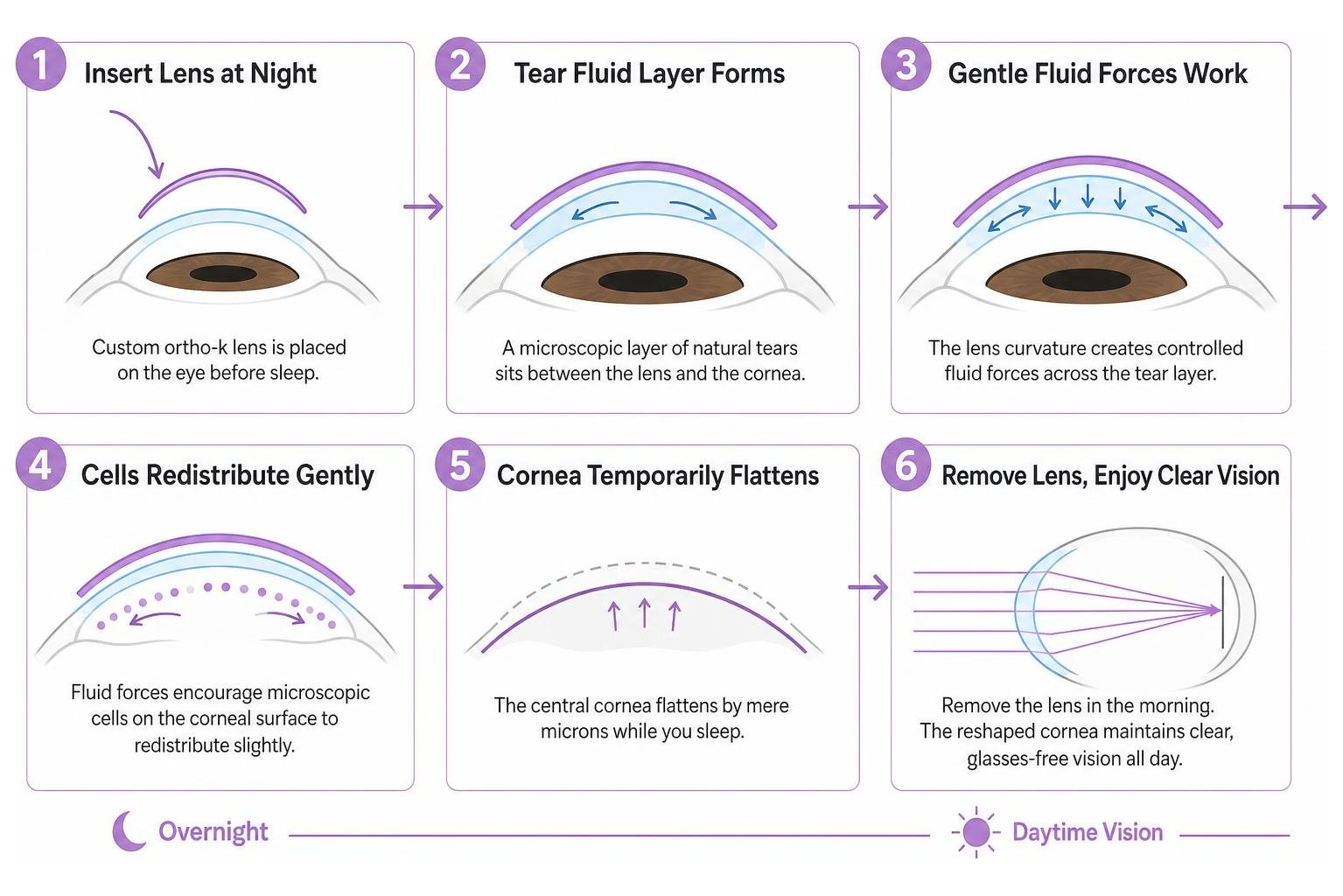
When placed on the eye before bed, a microscopic layer of natural tear fluid sits between the lens and the front surface of your eye. The specialised curvature of the lens creates controlled fluid forces across this tear layer. As you sleep, research suggests these forces may influence the very thin surface layer of corneal cells, known as the corneal epithelium, so the front surface of the eye temporarily adopts a slightly different shape.
This temporary reshaping gently changes the central corneal curve by mere microns. When you wake up and remove the lenses, the central corneal curve can remain modified throughout the day, allowing light rays entering the eye to focus more accurately onto the retina without needing daytime spectacles or conventional daytime contact lenses.
The process functions similarly to an orthodontic retainer for teeth. Just as a retainer supports tooth alignment overnight to maintain position, ortho-k lenses provide a nightly mould that temporarily maintains corneal curvature for clear daytime focus.
How Light Enters the Reshaped Cornea
The cornea is the transparent front window of the eye, responsible for a significant portion of the eye’s total focusing power. In an eye with short-sightedness, light rays converge in front of the retina rather than directly on it, creating distance blur.
By temporarily changing the surface shape of the cornea, ortho-k adjusts the optical power of the central cornea. This temporary shift can help direct central light rays more accurately onto the retina, providing clearer uncorrected vision during waking hours. Because this process works at the front surface of the cornea rather than permanently removing or altering deeper structural corneal tissue, it provides a flexible optical alternative.
Reversibility and Corneal Elasticity
A major feature of orthokeratology is its complete reversibility. Unlike refractive laser surgery, which permanently modifies structural stromal tissue, ortho-k works within the natural elasticity and self-renewing nature of the corneal epithelium.
If you discontinue wearing the retainer lenses at night, the epithelial layer naturally regenerates and returns to its baseline curvature within a matter of days to weeks. Because the reshaping is temporary, consistent nightly wear is necessary to sustain clear daytime visual focus.
A Personalised Ortho-K Experience: Who Is a Suitable Candidate?
Orthokeratology offers an appealing option for a broad range of individuals seeking daytime visual freedom. An attentive initial assessment helps our team determine whether your corneal shape, general ocular health, and personal goals align with the capabilities of overnight reshaping lenses.
Ideal adult candidates often include:
- Active adults and sports enthusiasts who find spectacles or daytime contact lenses inconvenient during training, running, or gym workouts.
- Swimmers, surfers, and water sports participants who want to reduce the contamination risks associated with wearing daytime contact lenses in pools or ocean water.
- Individuals working in dusty, windy, or air-conditioned work environments where daytime contact lenses frequently cause irritation or sore eyes.
- Adults exploring non-surgical vision correction who prefer a completely reversible option or who are unsuitable candidates for laser eye surgery.
Orthokeratology is also well suited for mature adults who are experiencing the natural age-related loss of close-up focusing (presbyopia). In these cases, your optometrist can design monovision lens configurations, where one eye is optimised for distance vision and the other eye is gently shaped for intermediate or near visual tasks. While bifocal contact lenses are not an option offered at our practice, monovision ortho-k fitting strategies provide a versatile approach for daily visual tasks.
Younger individuals may also benefit significantly. At The Focal Point Optometrist, our practice can fit individuals across various age brackets, including children of any age, depending on their individual willingness and desire to learn good lens handling. For young people experiencing progressing short-sightedness, overnight lenses serve a dual purpose by delivering clear daytime vision and acting as a primary clinical strategy within orthokeratology for myopia control in kids. You can explore broader background details on childhood vision development in our in-depth guide to myopia and our guide on contacts for kids: the ultimate safety and age guide.
If you would like to explore whether you are a candidate, you can Book an Eye Test or reach out through our Contact Us page.
What Is Involved in the Step-by-Step Ortho-K Fitting Process?
Fitting orthokeratology lenses requires precision, careful diagnostic planning, and close clinical monitoring. Because every cornea possesses unique microscopic contours, lenses must be custom-engineered to match the exact geometric profile of your eyes.
Step 1: Initial Information and Assessment Consultation
The orthokeratology journey begins with a dedicated, comprehensive one-hour appointment. During this consultation, we take the time to thoroughly discuss the option of ortho-k, assess your visual history, explore your lifestyle goals, and answer all your questions.
To ensure complete clarity and dedicated time for discussion, scans and corneal topography are not performed during that initial appointment; the patient returns for them to begin the fitting process. This initial one-hour discussion ensures that you have all the necessary information before making a commitment. When attending your appointments at our Perth clinic, please remember to bring your Medicare card so we can update your patient records.
Step 2: Corneal Mapping and Custom Lens Design
When you return for your dedicated diagnostic fitting appointment, we perform advanced, non-invasive digital corneal topography. A corneal topographer projects rings of light onto the eye surface to capture thousands of individual data points, creating a high-resolution map of your cornea.
Our optometrists use this precise elevation data to custom design your bespoke rigid gas-permeable lenses. These lenses are fabricated from specialised, highly oxygen-permeable materials that ensure ample oxygen reaches the cornea throughout the night.
Step 3: Lens Collection, Training, and Adaptation Schedule
Once your custom lenses arrive from the laboratory, you attend a comprehensive collection visit. During this appointment, we provide thorough, hands-on instruction covering:
- Hygienic preparation, washing, and drying techniques.
- Lens insertion using conditioning solutions.
- Centring and gentle removal techniques using specialised removal tools.
- Daily cleaning, disinfecting, and case maintenance.
We then establish a structured review schedule to monitor your ocular health, corneal response, and visual progress. Typical review intervals include:
- First-Morning Review: An appointment scheduled early in the morning following your very first night of wear (often with the lenses in place or immediately after removal) to evaluate initial corneal response.
- One-Week Review: Assessing visual adaptation, lens fit, and corneal surface health after seven consecutive nights.
- One-Month Review: Verifying corneal stability, day-long visual clarity, and tear film integrity.
- Ongoing Regular Reviews: Periodic check-ups every six to twelve months to monitor long-term ocular health and check the condition of your lenses.
You can establish your baseline eye health by booking a comprehensive eye test with our experienced team.
Consistency and Maintenance in Overnight Corneal Reshaping
Determining suitability for ortho-k involves a holistic evaluation of your corneal shape, refractive script, and daily lifestyle. During your consultations, your optometrist takes the time to assess whether overnight reshaping provides the right solution for your visual goals.
Because ortho-k is temporary, clear daytime vision depends on regular overnight wear and ongoing review. If lens wear is paused, the corneal surface gradually returns toward its original shape, so your optometrist will explain how often to wear your lenses, when to use backup spectacles, and what changes should prompt a review.
Good long-term results also depend on lens centring and eye comfort. Review appointments allow your optometrist to check corneal topography, lens condition, tear film quality, and any signs of irritation before small concerns become harder to manage.
If you would like to explore your options, you can Book an Eye Test or reach out via our Contact Us form.
Protecting Long-Term Ocular Health and Maintenance
Diligent hygiene and consistent lens maintenance are essential for ensuring safe, successful long-term orthokeratology wear. Rigid gas-permeable materials are durable and resist deposit build-up well, but they require dedicated daily care.
Daily Cleaning and Disinfection Protocol
Developing a consistent morning and evening routine keeps your lenses clean and protects the delicate corneal surface:
- Hand Washing: Wash hands thoroughly with antibacterial soap and dry them completely with a clean, lint-free towel before touching your lenses or eyes.
- Morning Removal: Apply a drop of approved lubricating rewetting solution to each eye before removal to ensure the lens moves freely over the tear layer. Use your prescribed manual technique or suction tool to remove the lens gently.
- Cleaning and Rinsing: Place the lens in your palm, apply the optometrist-recommended RGP cleaning solution, and gently rub the lens in a straight line back and forth for 15 to 20 seconds. Rinse thoroughly with sterile saline or approved conditioning solution. Never use tap water, bottled water, or saliva, as non-sterile water harbours dangerous micro-organisms like Acanthamoeba.
- Disinfection and Storage: Store lenses in fresh disinfecting solution inside a clean storage case. Ensure lenses remain submerged for the manufacturer-recommended duration before wearing them again. Discard used storage solution daily.
For an extensive walkthrough of hygiene best practices, refer to our clinical guide on how to care for contact lenses and keep your eyes healthy.
Clinical Safety and Professional Oversight
Like any contact lens modality, overnight wear requires responsible habits. The primary risk associated with contact lenses is microbial keratitis (a corneal infection). When strict hygiene guidelines and professional cleaning protocols are followed, the risk of complications remains low.
If you ever experience persistent redness, pain, unusual discharge, or sore eyes, remove your lenses immediately and do not reinsert them until your eyes have been assessed. Any therapeutic treatments required for acute ocular conditions must be assessed and managed by an endorsed optometrist, or referred to an ophthalmologist or General Practitioner (GP) where appropriate.
What to Expect During the First Month of Ortho-K Wear
Beginning orthokeratology is a journey of visual adaptation. Knowing what to expect at each stage helps you feel confident and supported as your eyes adjust to nightly lens wear.
Night One to Day Three: Initial Changes
After your very first night of wearing ortho-k lenses, you will likely notice a significant shift in your uncorrected vision upon waking and removing the lenses. While the initial improvement is exciting, your vision may soften toward the late afternoon or evening during the first few days as the epithelial cells gradually shift back toward baseline. Your optometrist may provide temporary low-powered spectacles to keep your vision functional throughout this transitional phase.
During the first few nights, you will also notice lens awareness when you place the lenses on your eyes before going to sleep. Because rigid gas-permeable lenses interact with your eyelids when blinking, some initial sensation is completely normal. Closing your eyes to sleep usually minimises this awareness quickly.
Week One to Week Two: Stabilisation
By the end of the first week of consistent nightly wear, corneal reshaping becomes much more stable. Most wearers find that clear daytime focus lasts throughout their entire waking day, from morning until bedtime. Visual clarity becomes sharper, and lens awareness upon insertion decreases as your eyes adapt to the nightly routine.
During your one-week review appointment, your optometrist assesses your corneal health, evaluates uncorrected daytime visual acuity, and checks corneal topography maps to ensure the lenses are centring perfectly overnight.
Month One and Beyond: Long-Term Visual Freedom
By one month, your corneal curvature has established a stable daytime profile. You can comfortably enjoy your daily routine, active sports, and work without needing daytime contact lenses or glasses. Attending regular review appointments every six to twelve months ensures that your corneas remain healthy and that your lenses continue to provide optimal performance.
Practical Solutions for Everyday Daytime Visual Freedom
When evaluating vision correction options, comparing orthokeratology with conventional alternatives across daily activities highlights its practical benefits.
| Feature / Consideration | Orthokeratology (Ortho-K) | Daytime Soft Contact Lenses | Standard Spectacles |
|---|---|---|---|
| Daytime Eyewear Freedom | Complete daytime freedom without lenses or glasses | Requires lenses to be worn throughout waking hours | Requires glasses to be worn on the face |
| Sports & Water Activities | Helpful for swimming, surfing, and contact sports | Contamination risk in water; dislodgement risk | Inconvenient and vulnerable in active or wet sports |
| Environmental Comfort | Worn only during sleep; no daytime lens exposure | May cause irritation in air conditioning or wind | No direct eye contact; no lens exposure |
| Daily Maintenance | Strict daily cleaning and disinfection required | Daily disposables need no cleaning; reusables require care | Minimal maintenance (lens cloth cleaning) |
| Myopia Management Support | May support slowing axial eye growth in developing eyes | Specialised designs available; standard lenses do not | Specialised designs available; standard glasses do not |
Daytime Convenience Across Work and Leisure
For individuals with physically demanding occupations, outdoor trades, or active sporting lifestyles, daytime glasses and soft contact lenses present practical obstacles. Glasses can slip, fog, or break, while soft daytime lenses can attract dust or dislodge during physical contact. Ortho-k removes the need for daytime visual hardware, providing stable visual performance throughout the day.
Storage Case Care and Replacement Schedule
Even with diligent daily care, rigid gas-permeable lenses accumulate microscopic protein build-up and surface wear over time. Rinse your storage case with sterile saline daily, air dry it face down on a clean tissue, and replace it monthly. Bring your lenses to your routine eye test visits so your optometrist can inspect them under a biomicroscope. Scheduled lens replacements every one to two years help support ongoing corneal health and clear vision.
Navigating Your Path to Confident Daytime Vision
Orthokeratology represents a versatile, scientifically grounded, and completely reversible approach to vision correction. By gently reshaping the corneal surface overnight through natural fluid dynamics, ortho-k provides the freedom of uncorrected daytime focus while maintaining the flexibility to adjust or pause treatment at any time.
Whether you are exploring ortho-k for sports convenience, seeking freedom from daytime lens wear, or managing changing vision in a younger family member, an attentive, comprehensive consultation is the essential first step. At The Focal Point Optometrist in Perth, our independent practice prioritises thorough appointments and continuity of care, ensuring you always feel properly seen and heard.
If you are ready to discuss whether orthokeratology is right for you, we invite you to connect with our caring team:
Frequently Asked Questions About Orthokeratology
How quickly does vision adjust after starting ortho-k?
Many wearers notice an improvement in visual clarity after their very first night of wearing ortho-k lenses. However, full visual stabilisation typically develops over one to two weeks of consistent nightly wear. During the initial transitional period, your optometrist may provide temporary backup spectacles with a lower script to ensure functional vision while your corneas adapt.
What happens if I miss a night of wearing my lenses?
Because orthokeratology does not permanently alter corneal structure, the elastic corneal epithelial cells gradually return toward their natural curvature when lens wear is paused. If you miss a night, your daytime vision may soften slightly by the following afternoon. Resuming nightly lens wear promptly restores the desired corneal curvature and returns daytime visual clarity.
Can ortho-k lenses manage astigmatism or presbyopia?
Custom-designed orthokeratology lenses can manage mild to moderate corneal astigmatism alongside short-sightedness by incorporating specialised toric peripheral curves. For individuals experiencing age-related near-focus blur (presbyopia), your optometrist can design a monovision ortho-k fitting strategy, correcting the dominant eye for distance clarity and the non-dominant eye for intermediate and near visual tasks. A comprehensive assessment with corneal mapping will determine whether your specific corneal shape and script parameters are suitable.