Understanding the Symptoms of Myopia and Protecting Your Vision
The common symptoms of myopia are usually linked to difficulty seeing clearly at a distance. You may notice blurry distance vision, frequent squinting, sore eyes after visual effort, poorer clarity in dim light, holding reading material unusually close, or moving closer to screens, boards, signs, or presentations to see detail. Noticing squinting is especially important because it is one of the most common ways people try to sharpen distant objects when their vision is not clear.
Myopia, also called short-sightedness, means distant objects can appear blurred while close-up objects are often easier to see. Healthdirect Australia explains that short-sightedness can make distant objects look blurred, and an eye test with an optometrist can assess whether a refractive error is contributing to the change. This article focuses first on the everyday symptoms of myopia, then later explains which sudden symptoms need urgent eye care because they may point to a separate retinal concern.
Key Takeaways
- Squinting, blurry distance vision, and difficulty seeing boards, road signs, or presentations are key signs to watch for.
- Sore eyes can occur when the eyes and facial muscles work harder to sharpen distant detail.
- Low-light environments can make distance blur feel more noticeable, especially when driving at night.
- Children may not describe blurred vision clearly, so sitting closer to screens, rubbing the eyes, blinking often, or struggling to copy from a board may be important clues.
- Sudden flashes of light, a sudden increase in dark spots, or a curtain-like shadow are not routine myopia symptoms and need urgent clinical attention.
- Explore our dedicated myopia management optometrist services for comprehensive assessments.
Recognising how your eyes respond during daily routines allows you to seek timely professional guidance before small changes in clarity become more disruptive. At The Focal Point Optometrist, our independent Wembley team takes a thorough, personalised approach to eye tests, helping patients understand whether symptoms are linked to myopia, another refractive error, or a concern that needs further assessment.
Symptoms of myopia terms at a glance:
7 Key Symptoms of Myopia to Watch For
Understanding how your eyes process light helps explain why short-sightedness produces distinct physical sensations. In a standard eye, the cornea and crystalline lens bend incoming light rays so they focus cleanly on the retina at the back of the eye. When an eye develops short-sightedness, the physical shape of the eyeball is typically slightly longer from front to back, or the cornea curves too steeply. This causes light to converge at a focal point in front of the retina, leaving distant images soft and indistinct.
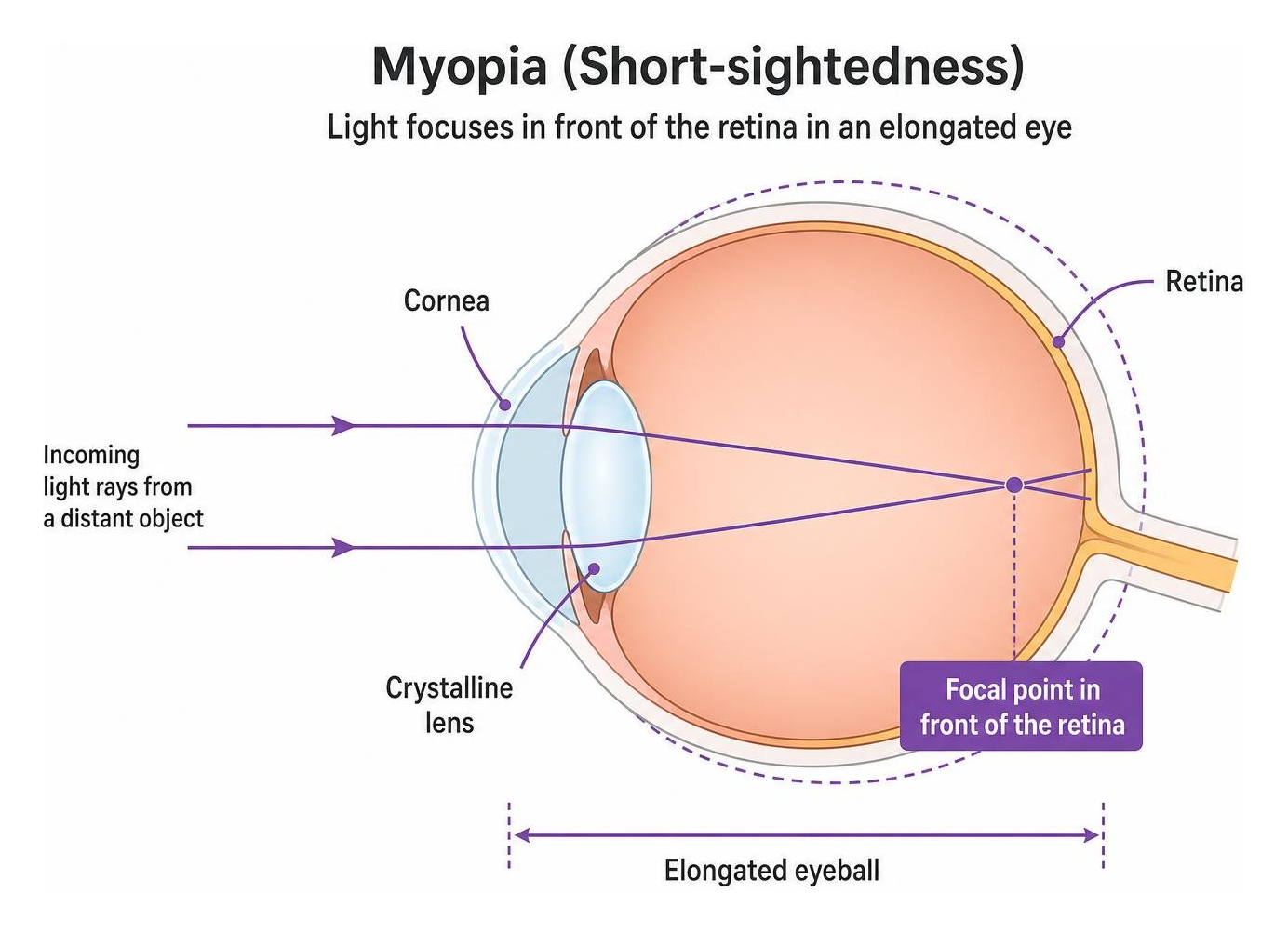
Because distant details do not resolve naturally, the visual system attempts to compensate. These seven symptoms are the main signs discussed in this article.
1. Blurry Distance Vision
The hallmark sign of short-sightedness is difficulty seeing objects across a room, across the street, or down the road. You might find yourself struggling to read overhead menu boards, recognise colleagues approaching from a distance, or decipher street signs while driving.
2. Squinting to Sharpen Distant Objects
When distance blur occurs, many people instinctively squint. Narrowing the eyelids creates a natural pinhole aperture. This physical narrowing blocks scattered peripheral light rays, allowing only central, parallel rays to enter the pupil. While this may temporarily sharpen the image on the retina, frequent squinting is a strong clue that distant detail is not resolving comfortably. If you often catch yourself narrowing your eyes to bring faraway detail into focus, an assessment for blurry vision can help identify the underlying refractive shift.
3. Eyestrain or Sore Eyes
Sustained visual effort can trigger asthenopia, commonly known as eye strain or sore eyes. When your eyes struggle to maintain clear distance focus, the visual system may work harder to interpret soft or indistinct detail. This can leave the eyes feeling tired, heavy, or uncomfortable after driving, watching a presentation, or looking across a classroom or workplace.
4. Low-Light Distance Blur
Some people notice that distance vision feels less reliable in dim settings, especially after sunset. This can make signs, road markings, or distant faces feel softer than they do in brighter conditions.
5. Night or Low-Light Vision Difficulty
Some individuals notice that their distance vision feels adequate in bright daylight but deteriorates significantly after sunset. This phenomenon, often referred to as night myopia, occurs because our pupils naturally dilate in low-light settings to gather more ambient illumination.
As the pupil enlarges, light passes through the outer edges of the cornea and crystalline lens. This exposure can increase spherical aberrations, causing light rays to bend inconsistently and focus further in front of the retina. The result may include increased glare, halos around streetlights and headlights, reduced contrast sensitivity, and difficulty judging distance during evening driving.
6. Holding Books, Phones, or Menus Unusually Close
People with short-sightedness often bring reading material, smartphones, or menus closer to the face because near objects remain easier to see than distant ones. While this habit can feel natural, it may be a clue that the eyes are relying on close working distances to maintain comfort and clarity.
7. Moving Closer to Screens, Boards, Signs, or Presentations
Another common sign is needing to move closer to television screens, classroom boards, presentation slides, or road signs to see fine detail clearly. Children may sit closer to screens or struggle to copy from the classroom board, while adults may notice difficulty with presentations, live events, or unfamiliar road markers.
To ensure your vision remains clear in all lighting conditions, you can Book an Eye Test with our team or Contact Us to discuss your visual concerns, and remember to bring your Medicare card along to your consultation.
Identifying Short-Sightedness Across Different Ages

Visual demands evolve throughout life, and the way short-sightedness manifests can differ significantly between children, working adults, and mature individuals. For an overview of how this refractive error develops over time, our in-depth guide to myopia provides foundational insights into optical development.
Recognising the Early Symptoms of Myopia
In its initial stages, short-sightedness can develop gradually. People often adapt without realising their distant clarity has slipped. You might simply find yourself avoiding distant visual tasks, sitting closer to the television, or feeling more tired after an afternoon commute. Understanding myopia causes demystified helps illustrate why prolonged near-work demands and genetics can encourage axial elongation over time.
Behavioural Signs in Children
Young children rarely report that their vision is blurry because they have no external reference point for how clear the world ought to look. Instead, parents, carers, and teachers must look for subtle behavioural clues.
Common childhood indicators include:
- Moving unusually close to television screens or holding tablets inches from their nose.
- Frequently rubbing their eyes or blinking excessively during visual play.
- Struggling to copy notes from the classroom whiteboard, leading to lower engagement or academic frustration.
- Showing a shortened attention span during activities that require switching focus between near and distant objects.
- Closing or covering one eye when looking at distant items.
Early detection through dedicated children’s eye tests allows an optometrist to assess focusing dynamics and support developing visual pathways.
Adult-Onset Indicators and Lifestyle Impact
While short-sightedness frequently begins in school years, adults can also experience shifts in their distance clarity. Adult-onset changes are often linked to visual stress, extensive computer work, shifts in overall systemic health, or early changes within the crystalline lens.
Adults often notice:
- Difficulty reading motorway exit signs until they are very close.
- Visual fatigue and sore eyes at the end of the workday.
- Increased sensitivity to glare when driving at night.
- Relying heavily on passenger guidance because road markers are difficult to resolve in unfamiliar areas.
If you suspect your distance clarity is changing, you can arrange a consultation with our clinical team to explore dedicated management strategies.
How Short-Sightedness Compares to Other Refractive Conditions
To better understand your vision, it helps to distinguish short-sightedness from long-sightedness (hyperopia). While both are common refractive errors, they affect the eye’s focusing system in different ways.
Short-sightedness occurs when the eye is relatively long or the cornea is steep, focusing distant light in front of the retina. Long-sightedness occurs when the eyeball is relatively short or the focusing power is too weak, meaning the eyes may need to work harder to maintain comfortable focus, particularly for near tasks.
Comparing the Symptoms of Myopia and Hyperopia
| Feature | Short-Sightedness (Myopia) | Long-Sightedness (Hyperopia) |
|---|---|---|
| Primary Visual Blur | Distant objects appear blurry; near objects are typically clear. | Vision may be clear in some people, but near tasks often require extra focusing effort and may become uncomfortable. |
| Optical Mechanism | Light focuses in front of the retina due to an elongated eyeball or steep cornea. | Light focuses behind the retina due to a shorter eyeball or flatter cornea, so the focusing system may compensate. |
| Common Symptoms | Squinting at distances, night driving glare, distance blur. | Sore eyes, visual fatigue, or discomfort during reading and other near-work tasks. |
| Developmental Pattern | Often develops in childhood or adolescence and may progress during growth. | More common in early childhood and may change naturally as a child grows. |
An optometrist can assess these refractive differences during an eye test to ensure you receive the appropriate optical correction.
Professional Assessment and Emergency Red Flags

A comprehensive eye assessment does far more than determine your optical script. In our independent Perth practice, initial consultations run for approximately one hour. This allows our optometrists to take an attentive, unhurried approach, evaluating refractive power, binocular coordination, and internal retinal health.
Regular eye tests provide a baseline to monitor subtle shifts over time. When advanced management options such as orthokeratology are considered, the process begins with a comprehensive one-hour appointment to discuss the option and provide detailed information. Diagnostic scans and corneal topography are not performed during that initial appointment; the patient returns for them at a subsequent visit to begin the fitting process.
Where progressive optical management is indicated, options such as MiSight contact lenses or orthokeratology may be discussed. Our practice can fit children of any age with contact lenses, depending entirely on the child’s willingness and desire to learn. For adults seeking flexible optical solutions, monovision lenses are an available option offered by our business. Therapeutic treatments require assessment by an endorsed optometrist, while surgical matters are referred to a specialist ophthalmologist, and patients requiring oral antibiotics are referred to a General Practitioner (GP).
Critical Retinal Symptoms Requiring Immediate Care
Most day-to-day symptoms of myopia involve distance blur, squinting, and visual comfort. However, some sudden visual changes are different from routine short-sightedness symptoms and should be treated as urgent warning signs.
Seek urgent medical care or access emergency eye care immediately if you experience any of the following warning signs:
- A sudden shower of dark spots or cobweb-like specks across your visual field.
- Bright flashes of light (photopsia), particularly in your peripheral vision, that occur in dim light or when moving your eyes.
- A dark shadow or curtain-like veil pulling across any part of your peripheral or central visual field.
- A sudden, painless loss or distortion of your vision.
These signs are not typical everyday myopia symptoms. They require prompt clinical triage by an eye health professional to protect your vision.
Nurturing Clear Sight and Lasting Optical Health
Recognising changes in your visual comfort is the first step towards maintaining clear vision and supporting your overall eye health. Whether you are noticing distant blur on your daily commute, experiencing sore eyes after visual tasks, or observing that your child sits closer to the television, our independent practice in Wembley is here to help.
Our team takes the time to listen, ensuring every patient feels properly seen and heard throughout their visual journey. We invite you to explore tailored care for you and your family with our dedicated clinical team. Please remember to bring your Medicare card along to your appointment.
To schedule your visit or speak with our staff:
Frequently Asked Questions About Myopia Symptoms
Can myopia cause sore eyes?
Uncorrected short-sightedness can contribute to sore eyes and visual fatigue, particularly if a person squints often to sharpen distant detail. If discomfort is frequent, worsening, or accompanied by other symptoms, your optometrist or General Practitioner (GP) can help assess whether another cause may be involved.
What is night myopia and why does it occur?
Night myopia refers to difficulty seeing clearly in dim lighting or while driving after dark, even if your vision feels adequate during the day. In the dark, your pupils naturally dilate, which exposes the outer edges of the cornea and crystalline lens. This creates spherical aberrations that bend light rays more sharply, focusing them further in front of the retina. The resulting blur, glare, and light halos can be assessed by your optometrist.
How does uncorrected myopia impact learning and day-to-day activities?
Uncorrected short-sightedness can make it harder for a child to read classroom boards, participate in sports, and maintain focus, potentially leading to visual fatigue and reduced classroom engagement. In adults, uncorrected distance blur can make day-to-day activities such as driving, reading signs, watching presentations, or navigating unfamiliar places more difficult. You can explore your family’s visual profile by completing our myopia management quiz, and check your myopia management quiz results for further guidance.