When Two Eyes See Two Different Worlds
Anisometropia and strabismus are two distinct but often interconnected vision conditions that affect how your eyes work together. Here’s what you need to know:
Quick Answer:
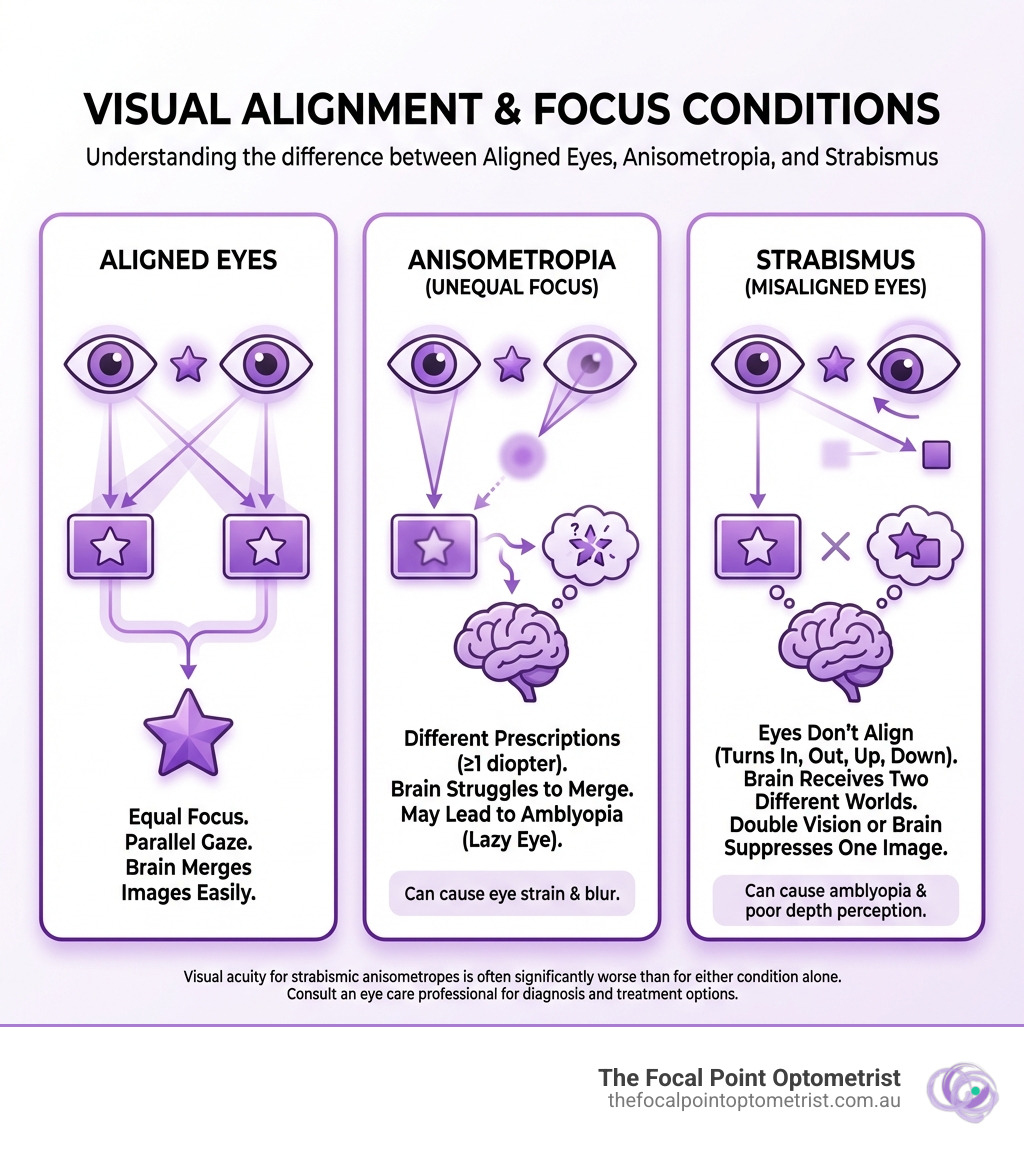
- Anisometropia means your eyes have different prescriptions (a difference of 1 diopter or more).
- Strabismus means your eyes don’t align properly (one eye turns in, out, up, or down).
- The connection: Anisometropia can lead to strabismus because your brain struggles to merge two very different images, and strabismus can worsen anisometropia by disrupting normal eye development.
- Impact: Both conditions can cause amblyopia (lazy eye), poor depth perception, eye strain, headaches, and double vision.
- Treatment: Corrective lenses, vision therapy, and in some cases, surgical intervention.
Vision is more than just reading the bottom line on an eye chart. It’s about how well your two eyes team together, how efficiently your focusing system works, and how accurately your brain interprets the images coming through. When one eye has a significantly different prescription than the other, or when your eyes don’t point in the same direction, this delicate system breaks down.
Why does this matter? Research shows that approximately 28% of people experience some degree of anisometropia, and the prevalence of strabismus ranges from 2-5% in the general population. More importantly, these conditions account for a significant portion of amblyopia cases—the leading cause of vision loss in one eye for both children and adults.
The relationship between these two conditions is complex. For example, significant long-sightedness in one eye (hyperopic anisometropia) can lead to amblyopia. Conversely, an early eye turn (strabismus) can disrupt the eye’s natural development, causing anisometropia. When both conditions exist together, visual function can be significantly worse than with either condition alone—studies show visual acuity for strabismic anisometropes was on average 2.5 times worse than for non-strabismics with similar anisometropia.
I’m Bernie Eastwood, and in my two decades as an optometrist and founder of The Focal Point Optometrist, I’ve seen countless adults struggling with the effects of anisometropia and strabismus—often undiagnosed or inadequately managed. These conditions require more than a quick prescription update; they demand a comprehensive, personalised approach that addresses how your visual system functions as a whole.
Understanding Anisometropia: When Your Eyes Have Different Prescriptions
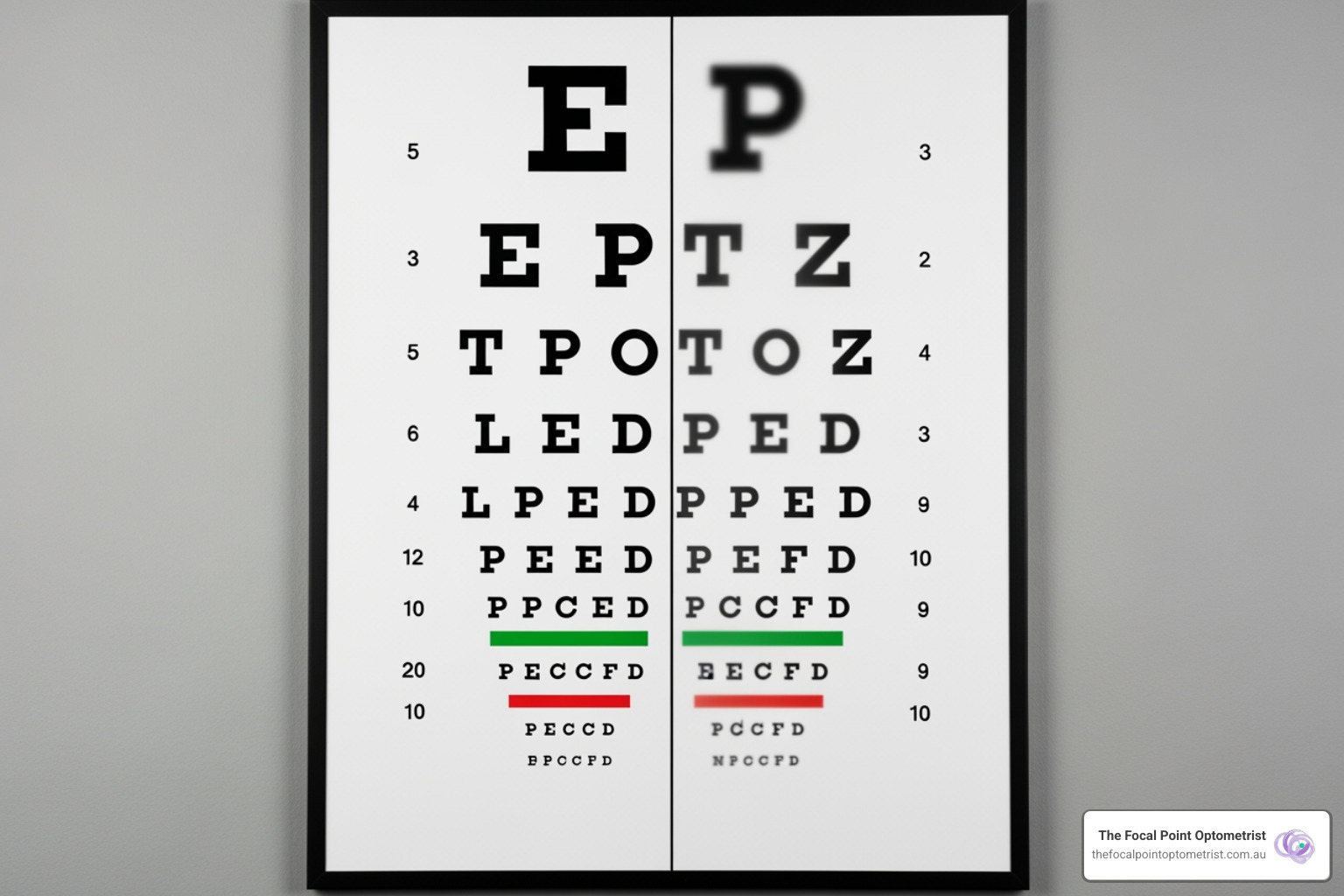
Imagine trying to read a book where one eye sees the page clearly, but the other sees it slightly blurred. This is the daily reality for individuals with anisometropia. Anisometropia is a condition where there’s a significant difference in the refractive error between your two eyes, typically defined as 1 diopter or more. This unequal prescription means that each eye sends a different image to your brain, creating a challenge for your visual system.
The impact of anisometropia can vary, but it often leads to visual discomfort and can affect your ability to see clearly. While it can be present from birth (congenital), it can also develop later in life (acquired) due to factors like eye trauma, ocular pathologies such as cataracts or keratoconus, or even as a complication of eye surgery. These acquired causes highlight that anisometropia isn’t just a childhood issue; it can emerge or worsen at any age.
What is Anisometropia and How Does it Differ?
Refractive error is essentially how your eye focuses light. Common refractive errors include myopia (short-sightedness), hyperopia (long-sightedness), and astigmatism (blurred vision at any distance). In anisometropia, the concern isn’t just having one of these refractive errors, but having a substantial difference in the degree or type of error between your two eyes.
For example, one eye might be perfectly focused while the other is significantly short-sighted. Or perhaps both eyes are long-sighted, but one requires a much stronger correction. This difference, greater than 1.00 diopter, creates unequal prescriptions. Your brain, designed to seamlessly merge two similar images into one clear, three-dimensional perception, struggles when the images are so disparate. This can lead to your brain favouring the clearer eye and suppressing the image from the blurrier one, which can have significant long-term consequences, even in adulthood. Unlike other refractive errors that affect both eyes similarly, anisometropia introduces an imbalance that profoundly impacts how your entire visual system functions.
The Different Types of Anisometropia
Anisometropia isn’t a single condition; it manifests in several forms. Understanding these types helps us tailor the most effective treatment plan for you. The main types include:
- Simple Anisometropia: One eye has normal vision, while the other is either short-sighted (myopic) or long-sighted (hyperopic).
- Compound Anisometropia: Both eyes have the same type of refractive error (e.g., both are long-sighted), but with a significant difference in prescription strength.
- Mixed Anisometropia: One eye is short-sighted, and the other is long-sighted, creating a very challenging scenario for the brain.
- Astigmatic Anisometropia: Any of the above types can also involve astigmatism (an imperfection in the eye’s curvature), further complicating the visual imbalance.
These variations highlight the complexity of the condition and why a comprehensive assessment is crucial to pinpoint the exact nature of your anisometropia.
Common Causes: Why Do Eyes Develop Unequal Prescriptions?
The reasons behind unequal prescriptions are diverse, ranging from congenital factors to changes that occur later in life.
- Congenital Factors: Many cases are present from birth, often due to hereditary differences in the eyes’ physical structure. While some cases in infants resolve on their own, many persist and require intervention.
- Acquired Causes in Adults: Anisometropia can also develop or worsen in adulthood, which is particularly relevant for our adult clients.
- Eye Surgery Complications: Procedures like retinal detachment surgery or cataract surgery can induce significant refractive changes and anisometropia.
- Ocular Pathology: Conditions like keratoconus, which alter the cornea’s shape, can lead to progressive and asymmetrical refractive errors. Other diseases affecting the cornea, lens, or retina can also contribute.
- Natural Age Changes & Trauma: As we age, the uneven development of cataracts is a common cause of acquired anisometropia. Trauma to one eye can also cause an imbalance.
The Complex Link: Anisometropia and Strabismus
The relationship between anisometropia and strabismus is a classic example of how interconnected our visual system is. While anisometropia refers to a difference in prescription, strabismus is about eye misalignment. These two conditions frequently coexist and can influence each other’s development and severity. When your brain receives images of vastly different clarity from each eye due to anisometropia, it struggles to fuse them. This conflict can lead to the brain ignoring the image from one eye (suppression).
Research has extensively explored this intricate connection. You can dig deeper into the scientific understanding of this relationship through Observations on the Relationship between Anisometropia, Amblyopia and Strabismus.
What is Strabismus (Crossed Eyes)?
Strabismus, commonly known as “crossed eyes” or an “eye turn,” is a condition where your eyes are misaligned. Instead of both eyes looking straight ahead and working together, one eye may turn inward (esotropia), outward (exotropia), upward (hypertropia), or downward (hypotropia). This misalignment can be constant or intermittent, appearing only sometimes, perhaps when you’re tired or focusing intently.
The primary function of our eyes working together is to provide us with binocular vision, which is crucial for depth perception (stereopsis). When strabismus is present, this coordinated effort is disrupted, impacting your ability to judge distances and maintain clear focus. Childhood Strabismus typically occurs either at birth or becomes noticeable around the ages of 18 months – 3 years. If an eye starts turning in later childhood or in adulthood it requires immediate assessment.
The Causal Relationship Between Anisometropia and Strabismus
The connection between anisometropia and strabismus is bidirectional, meaning one can cause or contribute to the other.
- How Anisometropia Can Lead to Strabismus: When one eye has a significantly different prescription, the brain receives a clear image from one eye and a blurred image from the other. To avoid confusion or double vision, the brain may suppress the blurred image. This constant suppression can weaken the neural pathways from the suppressed eye, making it more prone to drift out of alignment. For instance, significant long-sightedness in one eye is a known risk factor for an inward eye turn (accommodative esotropia).
The Critical Role of Amblyopia (Lazy Eye)
Amblyopia, commonly known as “lazy eye,” is a significant consequence when anisometropia and/or strabismus are present. It’s a condition where the brain learns to ignore the visual signals from one eye, even when the eye itself is physically healthy. This occurs because the brain prefers a clearer or more aligned image.
- Anisometropic Amblyopia: If one eye’s image is much blurrier due to anisometropia, the brain will naturally rely on the clearer eye and suppress the other. This chronic suppression leads to undeveloped vision, or anisometropic amblyopia. It’s often insidious because the eyes appear straight, making it hard to detect without a comprehensive eye exam. Anisometropic amblyopia accounts for 24-37% of all amblyopias.
- Strabismic Amblyopia: If an eye is constantly misaligned due to strabismus, the brain will suppress the image from that eye to prevent double vision, leading to strabismic amblyopia.
- Combined Amblyopia: These conditions often coexist. About one-third of amblyopia cases are caused by anisometropia, one-third by strabismus, and one-third by a combination of the two.
Amblyopia is the primary cause of unilateral vision loss in adults who didn’t receive treatment in their childhood. The good news is that with appropriate intervention, vision can often be improved, even in adulthood. You can find more information about amblyopia and its management by visiting our dedicated page on Amblyopia.
How Anisometropia and Strabismus Affect Vision in Adults
While often diagnosed in childhood, anisometropia and strabismus can significantly impact adults, whether these conditions persisted from youth or developed later in life. For adults, the symptoms can be particularly disruptive, affecting daily activities, work performance, and overall quality of life. We often see clients experiencing:
- Poor Depth Perception: The ability to accurately judge distances (stereopsis) relies on precise binocular vision. When anisometropia or strabismus disrupts this, you might struggle with tasks requiring fine motor skills, navigating stairs, or even simple activities like pouring a drink.
- Difficulty with Night Driving: Reduced binocular function and potential visual distortions can make night driving particularly challenging and stressful.
- Reading Fatigue: Sustained close-up work can quickly become exhausting, leading to decreased productivity and discomfort.
These symptoms can make you feel visually “unbalanced” and can be a source of significant frustration.
Aniseikonia: When Perceived Image Sizes Don’t Match
One of the unique challenges adults with anisometropia face is aniseikonia. This occurs when there is a difference in the perceived size or shape of images between your two eyes. Unlike simple blur, aniseikonia means your brain is receiving two images that are not only different in clarity but also in their actual size.
Your brain’s ability to create a single 3D image depends on receiving two similarly sized pictures from your eyes. When anisometropia causes them to be different sizes, your brain struggles immensely. This “fusion problem” can lead to a host of uncomfortable symptoms, including:
- Visual Distortion: Objects might appear warped, tilted, or shifted in space.
- Headaches and Dizziness: The constant effort to reconcile the disparate images can trigger frequent headaches, eye strain, and a general feeling of disorientation or dizziness.
- Nervousness or Imbalance: Some individuals report feeling off-balance or experiencing a sense of unease.
- Spectacle Intolerance: Traditional spectacles can sometimes exacerbate aniseikonia by further magnifying or minifying images, making them uncomfortable or unusable.
Aniseikonia is thought to start causing symptoms when the image size difference is over 0.75%, with definite symptoms present at 1-3%. Differences over 5% are often incompatible with comfortable binocular vision. This is a complex condition that requires careful evaluation. For a more detailed understanding of this condition, you can refer to Aniseikonia: Causes, Evaluation, and Management.
Challenges with Depth Perception and Binocular Vision
A cornerstone of comfortable, efficient vision is stereopsis, our ability to perceive depth and three-dimensionality. This sophisticated skill requires both eyes to work together, sending slightly different perspectives to the brain, which then merges them into a single, rich, 3D image.
When anisometropia and strabismus disrupt this delicate process, your depth perception can be significantly compromised. For adults, this can translate into:
- Difficulty Judging Distances: Simple tasks like reaching for an object, parking a car, or navigating uneven terrain can become surprisingly challenging.
- Clumsiness: You might find yourself bumping into things or misjudging steps, leading to an increased risk of falls.
- Issues with Sports and Hobbies: Activities requiring precise hand-eye coordination or spatial awareness, such as throwing a ball, playing golf, or even gardening, can become frustrating.
- General Visual Discomfort: The constant struggle for your eyes and brain to work together can lead to chronic fatigue and a general sense of visual inefficiency.
Even modest differences in refractive error can influence visual function, and while most pure anisometropes with interocular differences less than 4 diopters retain some stereopsis, the quality of this 3D vision is directly correlated with the acuity of the weaker eye. Our comprehensive Binocular Vision Testing provides a thorough assessment of how your eyes work together, helping us identify and address these challenges.
Diagnosis and Modern Treatment Approaches
At The Focal Point Optometrist in Wembley, Perth, we understand that vision is a complex system involving not just the eyes, but also how they team, how their focusing systems operate, and how efficiently the brain interprets visual information. Accurate diagnosis is the cornerstone of effective management for conditions like anisometropia and strabismus. We pride ourselves on a non-rushed, comprehensive approach, ensuring we understand your unique visual needs and lifestyle goals. This allows us to offer truly personalised management plans, helping you achieve a clearer, more comfortable vision.
How We Diagnose Anisometropia and Strabismus
Accurate diagnosis is paramount to effective treatment. At The Focal Point Optometrist, our highly qualified team takes a thorough, unhurried approach to your eye health. Our comprehensive eye examinations go beyond simply checking your visual acuity. We focus on understanding how your entire visual system works, ensuring we don’t miss subtle signs of imbalance.
Our diagnostic process typically includes:
- Detailed Patient History: We begin by listening carefully to your concerns. Questions about symptoms like headaches, eye strain, double vision, difficulty with depth perception, onset of symptoms, and family history are crucial. This helps us understand the impact these conditions have on your daily life.
- Visual Acuity Test: While this measures how clearly you see, it’s just one piece of the puzzle. We use various charts to assess your vision in each eye individually and together..
- Cover Test: This simple yet effective test helps us detect any eye turns (strabismus) by observing how your eyes move when one is covered and then uncovered. We assess for both manifest deviations (tropias) and latent deviations (phorias).
- Stereopsis Testing: We use specialised tests to evaluate your 3D vision, which is often compromised in individuals with anisometropia and strabismus. This helps us understand the extent of your binocular vision dysfunction.
- Binocular Vision Assessment: We look deeply into how your eyes team and focus together, evaluating skills like convergence, divergence, and accommodative facility. These assessments help us pinpoint any inefficiencies in your visual system that contribute to your symptoms.
- Ocular Health Check: A dilated fundus exam and other assessments are performed to rule out any underlying ocular pathologies (like cataracts or retinal issues) that could be causing or contributing to your anisometropia or strabismus.
Our commitment to a non-rushed, holistic approach ensures that we gather all necessary information to provide you with the most precise diagnosis and a clear understanding of your condition.
Advanced Treatment Options for Adults
Once we have a comprehensive understanding of your anisometropia and strabismus, we can discuss a personalised treatment plan customised to your specific needs and lifestyle. Our goal is to alleviate symptoms, improve visual comfort, and improve your overall visual function.
- Corrective Lenses:
- Specialised Spectacle Lenses: For many adults, precisely prescribed spectacles are the primary solution. For anisometropia, we can explore specialised designs of lenses, which are crafted to minimise image size differences (aniseikonia) between your eyes. This helps your brain fuse the images more comfortably and effectively. We have access to a wide range of frames, ensuring both optical precision and personal style.
- Prism Correction: For smaller degrees of strabismus or to alleviate double vision and eye strain, we can incorporate prism into your spectacle lenses. This helps to shift the image perceived by one eye, aligning it with the other and reducing the effort your eyes have to make to work together.
- Contact Lenses: In some specific cases of anisometropia, contact lenses can be a valuable option. They sit directly on the eye, which can reduce the image size difference (optical aniseikonia) compared to spectacles, potentially offering greater comfort and better binocularity for some individuals. We would discuss whether this is a suitable option for your unique situation.
- Vision Therapy as a Solution: Vision therapy is a cornerstone of our practice and offers a powerful, non-invasive approach to improving how your eyes and brain work together. Eyes are brain tissue, and like any other part of the brain, their function can be changed through targeted, regular activities.
- Vision therapy is a customised program of exercises designed to improve eye teaming, focusing, and movement skills. It helps to retrain your visual system, allowing your brain to better integrate the images from both eyes, reduce suppression, and improve depth perception.
- For adults with anisometropia, therapy can focus on enhancing the visual processing of the weaker eye and improving the brain’s ability to fuse disparate images. You can learn more about how we help with this on our Vision Therapy for Anisometropia page.
- For adults with strabismus, vision therapy aims to improve oculomotor control, expand fusional ranges, and reduce the frequency or magnitude of eye turns. Our Vision Therapy for Strabismus page provides more details.
- We believe that vision therapy is not a one-size-fits-all solution. Your program will be specifically customised to your individual needs and your goals for your vision and lifestyle.
- Surgical Options: In some severe cases of strabismus or for very high refractive errors that cannot be adequately corrected with lenses or therapy, surgical intervention may be discussed with an ophthalmologist. While we do not perform surgery, we work collaboratively with trusted specialists in Western Australia and can provide referrals and co-manage your care to ensure a seamless approach to your visual health.
Bringing Both Eyes Back to the Same Page
Anisometropia and strabismus are common, complex visual conditions that can profoundly affect how you experience the world. From persistent headaches and eye strain to debilitating double vision and compromised depth perception, these issues can impact your work, hobbies, and overall quality of life.
We firmly believe that vision is far more than just sight. It’s a dynamic, learned skill involving intricate teamwork between your eyes and brain. When this system is out of balance, a comprehensive, personalised assessment is crucial to uncover the root causes of your symptoms.
At The Focal Point Optometrist in Wembley, Perth, we are dedicated to providing exceptional eye care for adults. Our team of highly qualified professionals takes the time to truly understand your visual needs, never rushing you, and always engaging in meaningful conversation. We leverage our expertise in behavioural optometry to offer advanced solutions, including specialised spectacle lenses, prism correction, and customised vision therapy programs designed to improve your eye teaming, focusing, and movement systems.
Don’t let visual discomfort hold you back. If you suspect you have anisometropia or strabismus, or if you’re experiencing symptoms like eye strain, headaches, or difficulty with depth perception, we’re here to help. Take the first step towards clearer, more comfortable vision. Explore how a custom Vision Therapy for Anisometropia program can help you regain visual comfort and efficiency.
Book a comprehensive eye exam with our expert team today by visiting our contact page.